Our social:

Latest Post

Monday, April 24, 2017

Artichokes, lamb’s lettuce, asparagus, peas – now’s the time for the bright, fresh flavours of classic Alpine dishes Artichokes, lamb’s lettuce, asparagus, peas – now’s the time for the bright, fresh flavours of classic Alpine dishes

Easter time marks the march towards the brighter vegetables that I miss over winter: broad beans, asparagus and the first wild shoots feel like the first signs of spring. But the reality is that these things often take longer to arrive than we would like. If I’m left waiting for the next season’s produce, I eat greenly in a different way.

As a teenager, I was presented with a salad the memory of which has remained with me ever since. A friend of my mother’s, Irma, hosted us in a 17th-century cowshed, meticulously refitted and nestled in the Swiss Alps. The dish was simple: lamb’s lettuce (or mâche), raw carrot and hard-boiled egg with spicy vinaigrette. She said it was a Swiss classic and it sat in her repertoire of precisely delicious potato rostis, fondues and legendary breakfasts with hazelnut yogurt and Alpine cheeses. The salad epitomised freshness.

At this time of year, I am as likely to cook a salad leaf as eat it raw; use flavours such as my butter-laced anchovy and pine nut sauce to coat the vegetables I find; turn to warmth one way or another, be it in the inclusion of toasted breadcrumbs to a vegetable dish or adding a still-warm boiled egg to a salad.

It is in the spirit of Irma that these recipes have been written, with memories of streaming sun lighting the snow peaks outside, soft salads and spring flowers.

Lamb’s lettuce salad

The only cooking required here is to boil the eggs but this clever, delicate salad is more than the sum of its parts.

Serves 4
eggs 3 of the best you can get
lamb’s lettuce 200g
garlic ¼ clove
salt
herb and wine vinegar 1 tbsp
extra virgin olive oil 3 tbsp
carrot 1

Hard boil the eggs. Wash the leaves, give them a shake or gentle spin and leave them on a clean towel on the bench to dry. Crush the garlic with a pinch of salt and stir it into 1 tbsp vinegar and 3 tbsp extra virgin olive oil. Peel the carrot and slice it thinly on the bias and then slice again into matchsticks. Carefully mix the leaves and carrot with the dressing and serve with the sliced eggs.

Pasta mista with cod and peas
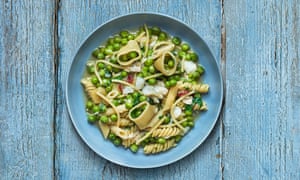
Peas to the world: pasta mista with cod and peas.
Peas to the world: pasta mista with cod and peas. Photograph: Jean Cazals for the Observer

Mixed pasta can be bought from Italian delis; or better yet, can be made using up all the little bits of leftovers in the packets lining your cupboard, snapping any longer shapes into shorter pieces. If you have a good supplier, feel free to use actual salt cod rather than this quick version of it, soaking the fish for several days in regular changes of water. But I really like this fresher version as well.

Serves 2
sea salt
cod 200g
onion 1, small
garlic 1 clove
chilli ½, dried
extra virgin olive oil a glug
parsley 4 sprigs
sage 3 leaves
lemon peel 3 strips
peas 250g (can be frozen)
pasta mista 150g

Liberally salt the cod and leave it unwrapped in the fridge overnight or up to 24 hours. Then rinse very well under cold water. The fish will feel pleasingly firm to the touch.

Sweat the onion, garlic and chilli in a glug of olive oil over a medium temperature for about 7 minutes. Chop some of the parsley stalks and sage and add them with the lemon peel. After a few minutes more, add the peas and cod, turn up the heat, stir once and add water to cover. Simmer for 15 minutes and add the pasta. Cover with more boiling water so all the pieces are submerged – but not drowning.

Cook, stirring all the while, adding more water when necessary until the pasta is al dente and the sauce thicker. Add more chopped parsley and serve with extra olive oil.

Artichokes and lettuce

Add the warmth of toasted breadcrumbs: artichokes and lettuce.
Add the warmth of toasted breadcrumbs: artichokes and lettuce. Photograph: Jean Cazals for the Observer

Serves 4
artichokes 6
lemon 1
breadcrumbs 4 tbsp
olive oil 2 tbsp, plus some for crumbs
red onion ½
garlic 2 cloves
salt a pinch
chilli 1 dried
lettuce 1, robust, such as Romaine
dried wild oregano 2 tbsp

Remove the tough outer leaves from the artichokes and trim the tops. Trim the stalks and peel them and the base of the artichokes. Cut in half and use a teaspoon to remove the choke. Cut each half into 4. Cut the lemon in half and rub on the artichokes if you care about them discolouring.

Heat the oven or gill. Coat the breadcrumbs with some oil and toast until golden.

Peel and slice the onion and garlic. Heat 2 tbsp of oil in a wide pan and sweat them with a pinch of salt and the chilli. When soft, add the artichokes and continue to cook over a medium heat, stirring. Wash and slice the lettuce in half and then each half into 6. Once the artichokes are mostly cooked add the lettuce, the oregano and a squeeze of lemon.

Cook stirring for 5 minutes and serve at once with the breadcrumbs.

Asparagus and broccoli with pine nuts and porcini

Getting fresh: asparagus and broccoli with pine nuts and porcini.
Getting fresh: asparagus and broccoli with pine nuts and porcini. Photograph: Jean Cazals for the Observer

This dish reflects a seasonal crossover. If it’s too early, don’t buy asparagus but use carrots or Swiss chard instead.

For the sauce
dried porcini 10g
olive oil a little
celery 1 stick with leaves cut into pieces
onion 2 thin slices
garlic 1 clove, sliced
pine nuts 15g
white wine 1 glass
anchovy fillets 2
butter 40g

asparagus 1 bunch
sprouting broccoli 200g

Soak the dried porcini in a cup of boiling water for 30 minutes. In a small pan heat a little olive oil and add the celery, onion and garlic.

Fry without colouring for about 7 minutes. Add the pine nuts and porcini and cook a moment longer before adding the porcini water, omitting any dust that may be at the bottom of the cup.

Cook until dry again and then add the wine. Reduce by half and then add the anchovies and butter in 2 pieces and whizz with a stick blender or food processor. Adjust the seasoning.

Boil the asparagus and broccoli together in salted water.

Dress with a little olive oil and serve with the warm sauce.

Joe Trivelli is joint head chef at the River Café. Nigel Slater returns in two weeks

Hot and cross with trad Easter fare? Try this Ukrainian sweet bun that’s similar to panettone – or sample some of the other Easter treats served up across Europe below Hot and cross with trad Easter fare? Try this Ukrainian sweet bun that’s similar to panettone – or sample some of the other Easter treats served up across Europe below

Sometimes called kulich, but we call it paska in the south, this is a slightly bonkers cousin of the Italian panettone, which I cook in cleaned-out tomato tins. Don’t be put off by the 12‑hour proving for the mashed potato starter – it adds a beautiful texture. We make A LOT of these during Easter, which is our biggest religious holiday.

Ukrainian Easter bread

Makes 3x 800g breads
For the starter
3 potatoes, peeled and chopped
1 litre cold water
3 tbsp plain flour

For the dough
250ml warm milk
15g fresh yeast or 7g dried active yeast
4 egg yolks, at room temperature
150g caster sugar
1kg plain flour
Sunflower oil
100g sultanas

For the glaze
175g icing sugar
2 tsp vanilla extract
2 tbsp water
Hundreds and thousands (optional)

1 For the starter, put the potatoes in a saucepan, cover with the water and bring to the boil. Cook for 15 minutes, or until quite soft.

2 Pour away all but 200ml of the cooking water and mash the potatoes with the remaining liquid.

3 Add the flour and mix well. Cover and leave in a warm place for 12 hours.

4 To make the dough, add the milk (make sure it’s warm but not hot) and the yeast to the starter and mix well.

5 Beat the egg yolks and the sugar in a large bowl with an electric whisk until foamy.

6 Fold the milk and yeast mixture into the egg mixture. Gradually sift in and mix in the flour – the dough should be firm, but not bouncy. Cover the dough with a clean tea towel and leave to raise in a warm place for about an hour.

7 Moisten your hands with some sunflower oil and knead the dough for about 15 minutes. Scatter the sultanas on your work surface and knead them into the dough.

8 Now, divide the dough into 4 pieces. Oil three cleaned 800g tomato tins and half fill them with the dough. Leave to prove in a warm place for 1 hour. Meanwhile, preheat the oven to 180C/350F/gas mark 4.

9 Put the tins on a baking tray and bake for 40-45 minutes on the lowest shelf of the oven. Let the bread cool fully in the tins, then run a palette knife around the edges to help free them.

10 To make the glaze, whisk the icing sugar, vanilla extract and water together in a bowl, then brush over the top of the breads, letting it drip along the sides. Decorate with hundreds and thousands, if you like.

This is an extract from Olia Hercules’s first book, Mamushka: Recipes from Ukraine and Beyond. Her second book, Kaukasis the Cookbook, will be published in August (both on Mitchell Beazley); octopusbooks.co.uk

Europudding: more Easter treats we’d like to try

The Finnish mämmi (called memma in Sweden) is a rye malt casserole, traditionally baked and available in birch bark baskets. It’s scented with bitter orange and served with cream and sugar or vanilla ice-cream. Magnus Nilsson’s incomparable Nordic Cookbook lists a recipe for it, as well as for a Finnish version of the Russian Orthodox Easter Sunday dessert: pasha or pashka, an ancient extravaganza of dried fruit, honey, nuts and curd cheese, moulded into a mound and inscribed with the first two Cyrillic letters, Х and р, of the Easter greeting, Христос βоскресе: Christ is risen.

Breads

Across Eastern Europe, from Georgia to Bulgaria, pashka is served with slices of kulich, or paska, as it’s known in southern Ukraine – in her first book Mamushka, Olia Hercules makes these puffy buns popping out of cleaned tomato tins, smothered in white icing and hundreds and thousands. The Greek tsourecki is a braided loaf, garnished with flaked almonds: find an excellent recipe in Rebecca Seal’s The Islands of Greece. And then you’ve got the sweetened brioche-like bite of the Italian pane di Pascua (replete with a coloured egg nestled in its middle), the Portuguese folar de pascoa (flavoured with caramel, aniseed and cinnamon)
the Croatian pinca (closer to our hot cross buns with a cross sliced into the dough before baking) and the German Osterbrot. Luisa Weiss, in Classic German Baking, makes bunny rolls with currant eyes for Easter morning. She also does an intriguing Poschweck loaf from Aachen, into which whole sugar cubes are baked. Can someone please send us one?

Cakes

Given the beauty that is the semlor lent bun – a wisp of a bun filled with sweetened cardamom cream – we are eager to try the Scandi cakes that follow over Easter: many Swedes opt for the Påskens chokladtårta while Trine Hahnemann tends towards apricot and citrus fruit in her Danish classic, påskekage, decorated with dainty marzipan leaves. Lastly, and as sonorously an ode to the springtime that Easter could ever usher in, the Alsatian lammele or agneau pascal: a beautifully airy génoise baked in the two halves of a lamb-shaped mould, and dusted with icing sugar. We would happily host this dinky critter in the middle of our Easter spread.

Two Easter recipes with a difference: a piquant herby muffin with a trickling treat inside, and a showstopping tart awash with greens and yellows to welcome the new season Two Easter recipes with a difference: a piquant herby muffin with a trickling treat inside, and a showstopping tart awash with greens and yellows to welcome the new season

Last Easter I went to my first egg-painting party. We sat around a table, blew the yolks and whites from thir shells until the eggs were satisfying little hollows, and we carefully painted them. I went for a Faberge creation in bright pastels; others were the faces of heavy-metal icons and cartoon characters. We hung them on some blossom branches and felt quite pleased with ourselves. The symbolism of it all struck me.

Eggs are an ancient symbol of new life, of promise and of hope and – whether you celebrate Easter or not – we all need a little of that just now. As a child, I waited and waited for this time of year, for the flowers to come out, to play outside. There is an optimism around that is worthy of celebration.

These recipes make a hero of the egg; they show it off in all its sunny-yolked glory. First, a tart that will sit at the middle of my Easter table. As tarts go, this is quick to make. It unashamedly uses good shop-bought puff pastry, though a homemade flaky pastry would certainly elevate it to another level if you had the time. It is a wash of green and yellow, using the first baby vegetables and broad beans (there are good Spanish ones in the shops now). I make this tart all through spring and summer, varying the vegetables as different things come into season – peas and leeks one time, asparagus and broad beans the next.

Then there are the muffins. If there is a recipe that makes more of an egg, then I am yet to find it. These are based on a muffin I ate at a brilliant bakery called Craftsman and Wolves in the Mission district of San Francisco. A whole egg hidden inside, the yolk still runny, it’s the perfect breakfast muffin: a little bite from polenta, a hit of chilli, some brightness from the dill. They also travel well to a picnic. But be sure to eat them hot straight from the oven if you want a runny yolk, as the yolk will set a little as they sit.

As eggs are the main event in both of these recipes, I’d encourage you to buy the very best ones you can get your hands on. For me, that means good organic eggs with paint-pot yellow yolks.

Sunny egg muffins

This is a recipe you will need to follow closely if you are after a runny egg. You will need to use a large, deep, nonstick large muffin or yorkshire pudding tin – normal muffin tins are too small. I used this one.

Makes 6 large muffins
6 medium eggs, at room temperature, for boiling
100g fine polenta
180g white spelt flour
1 tsp flaky salt (smoked works well)
1 tbsp baking powder
50g mature cheddar cheese, coarsely grated
4 spring onions, finely sliced
A small bunch of dill, finely chopped
¼ tsp dried chilli flakes
240ml buttermilk
90ml olive oil, plus a little extra for greasing
2 eggs

1 First, boil your eggs. Bring a large pan of water to a rapid boil, and lower in the eggs. Boil for exactly 4 minutes – not a second more. Remove from the pan and immerse into ice-cold water, then chill in the fridge for at least half an hour.

2 Meanwhile, get your muffin mix ready. In one bowl, mix together the polenta, spelt flour, salt, baking powder, grated cheese, spring onions, dill and chilli flakes.

3 In a jug, mix together the buttermilk, olive oil and eggs.

4 When you’re ready to bake the muffins, preheat your oven to 190C/375F/gas mark 5. Grease the moulds with a little oil. Get your eggs out of the fridge and peel them really, really carefully, putting them on a couple of sheets of kitchen roll to stop them rolling away.

5 Tip your buttermilk mix into your flour bowl and stir gently, not worrying too much about any lumps. Put a couple of tablespoons of the muffin batter into each mould, then very gently add an egg on top. Carefully add the rest of the batter so that you don’t squash the eggs, and immediately bake for 20 minutes – again, not a second longer.

6 Remove the muffins from the oven and take each one carefully out of its mould and transfer them to a cooling rack. Using a sharp knife, cut right through the middle of the muffin and pat yourself on the back for achieving a perfect soft yolk.

Easter egg and spring veg tart (main picture)

I used ready-rolled all-butter puff pastry here, but if you buy a block or make your own, then roll it out to just bigger than an A4 piece of paper, to about 2-3mm thick. This tart is best eaten straight out of the oven. The eggs are best cracked over at the last minute, too, so if you want to get ahead, do so with everything but the eggs until you’re ready to cook it. I like to double pod my broad beans, but if you buy baby ones they will be sweet and you might not need to. I serve this with a simple lemon-dressed green salad and some buttered new potatoes.

Serves 4

5 eggs, fridge-cold
320g puff pastry (I used a sheet of ready-rolled all-butter)
6 spring onions, trimmed and cleaned
6 baby courgettes, quartered lengthways
Olive oil
100g baby broad beans
150g creme fraiche
1 heaped tbsp dijon mustard
Zest of 1 lemon
Salt and pepper
To finish: herbs, hazelnuts, seeds of your choice

1 Preheat the oven to 200C/400F/gas mark 6. Crack one of the eggs into a cup with a big pinch of salt, beat well and leave to one side. Fill and boil the kettle.

2 Spread your puff pastry out on to a cold baking tray and trim off 1cm from each side and set aside. Working quickly, prick the base all over with a fork, and lightly brush with the beaten egg. Add the trimmed edges back on top of the pastry around the edges you cut them from, forming a border, and egg-wash those too.

3 Put the spring onions and baby courgettes on to a baking tray, drizzle with a little olive oil and season with salt and pepper. Bake, along with the puff-pastry case, for 20-25 minutes until the veg is golden and the pastry is really crisp.

4 Meanwhile, pour a little boiling water over the baby broad beans, allow them to cool, then pop each one out of its tough outer skin, leaving the bright-green bean inside.

5 As soon as the pastry comes out of the oven, press down on the middle rectangle of the base (which will have puffed up a little), leaving yourself a nice border around the outside.

6 Mix the creme fraiche with the mustard, add a little salt and pepper and spread it over the crisp pastry, keeping it within the border.

7 Arrange the courgettes and spring onions over the base, then make four little spaces to crack the eggs into. Stop here if you are preparing the tart in advance and cover and keep it in the fridge.

8 When you are nearly ready to eat, take the eggs out of the fridge and really carefully crack each one on to a saucer, then pick up the whole egg, leaving behind as much of the watery white as you can. Gently place each egg in the little wells, sprinkle over the broad beans and bake for 20 minutes, until the egg whites are set and the yolks are still a little soft.

9 Remove the tart from the oven, grate over the lemon zest and scatter over the hazelnuts or toppings of your choice.

  • This article was edited on 11 April to add a picture of the Sunny Egg Muffin to the recipe.

Some have reservations, but there are few things that aren’t improved by a dollop of salted caramel – and adding it to a squidgy, dark brownie is a no brainer Some have reservations, but there are few things that aren’t improved by a dollop of salted caramel – and adding it to a squidgy, dark brownie is a no brainer

Some of you, I know, have had your fill of salted caramel. You’re sick of finding it in everything from green tea to cider, still unconvinced by the idea of a savoury sweet, and that famous image of Nigella dripping head to toe in sugary, buttery saline goodness leaves you utterly cold. And I’m sorry for your loss, really I am. Because, to the rest of us, the attractions are all too clear: rich and buttery, with an intense caramel sweetness shot through with maritime undercurrents, it’s hard to think of many things that wouldn’t be improved by a dollop of the stuff. Certainly, once I had roasted a duck with miso caramel, redcurrant jelly began to look a little passe.

There are limits of course – potato crisps being one of them – but adding salted caramel to a chocolate brownie, squidgy, dark and bittersweet, feels like what might be termed in the brownie’s American homeland, a “no brainer”, assuming you concede there’s any room for improvement. Perhaps we can agree on the fact that a salted caramel brownie is not necessarily better than the ordinary kind, but it’s certainly no worse. Which makes it pretty much perfect as far as I’m concerned. (Note that this is also a good way to use up excess Easter chocolate, should such a thing exist in your household, although you may wish to adjust the sugar content depending on the sweetness of the stuff available.)

Edd Kimber
Edd Kimber adds double cream to his brownies. Photograph: Felicity Cloake for the Guardian

The caramel

This column has covered the basics of both brownies and salted caramel before, but together they’re a rather different proposition: what works as a standalone sauce does not necessarily have the right qualities for the best supporting actor role in a tray bake. If melting sugar makes you nervous, you can, of course, use ready-made caramel – Jane Hornby in BBC Good Food beats sea salt into the Carnation tinned variety, and Emily Pahl melts caramel sweets into double cream – but if you make it yourself, then you can make it perfect. For me, that means using sour cream, as New York bakers Matt Lewis and Renato Poliafito suggest, rather than Edd Kimber or Deb Perelman’s double cream. Sour cream gives the caramel a subtle tangy flavour that helps to balance the richness of the sugar and butter in there, too. I’m going to base my caramel on Perelman’s, however, which uses less cream than some of the others to make it less soft, but still manages, somewhat miraculously, to impress with its silky thickness.

Lewis and Poliafito put corn syrup in their caramel, I think to minimise the possibility of it crystallising in the pan, but as long as you allow the sugar enough time to melt, this shouldn’t be a problem. If you are worried, however, then a spoonful of the more readily available golden syrup will work just as well.

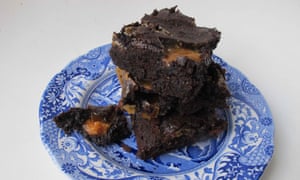
Emma Pahl brownies
Nigella Lawson described Emma Pahl’s brownies as the ‘best I ever made’. Photograph: Felicity Cloake for the Guardian

The brownie

Having, in the infancy of this column, laboured hard over my brownie recipe, I’m pretty pleased with it, even seven years on – but, having tasted five alternatives in the course of this week’s research, I have to concede it could do with a bit of tweaking to complement the all-new salted caramel filling. That said, I’m still of the school that prefers a dense, but not downright fudgy texture – both Perelman and Lewis and Poliafito’s versions, although as delicious as anything calling itself a salted caramel brownie can be, are too solid to take any more richness in the form of extra caramel. Beating the mixture until light and airy, as Kimber recommends, is still my own favoured technique and I’m also, like Nigel Slater, in defiance of many brownie aficionados, going to add a little baking powder, too.

To maintain as much contrast between the two flavours as possible, my recipe will use ordinary white or golden sugar rather than going down the toffeeish muscovado route, and there won’t be any caramel in the batter itself, as in Hornby’s recipe, for the same reason. Indeed, Perelman observes that many salted caramel brownies are “achingly sweet, as if little consideration was given to the fact that dousing an already-sweet brownie with caramel sauce might cause teeth to hurt/dentists to buy new vacation homes”. Like her, I’ll be reducing the amount of sugar in the batter to compensate, but, more importantly, I’ll be using the darkest chocolate I can find.

Jane Hornby beats sea salt into Carnation tinned caramel.
Jane Hornby beats sea salt into Carnation tinned caramel. Photograph: Felicity Cloake for the Guardian

The chocolate

Hornby reckons that “for best results, it’s important to use chocolate with the right mix of 70% and 50% cocoa solids [to] help to give the brownies their rich, fudgy texture”. Lewis and Poliafito call for a cocoa content of between 60% and 72%; Kimber is roughly the same at between 65% and 75%; and Emily Pahl of the She Makes and Bakes blog, whose recipe Nigella described in 2012 as the “best brownies I ever made”, calls for “bittersweet”, which, the internet informs me, is almost always more than 50%, but frequently around 70%. Perelman, however, goes the whole hog, and uses unsweetened chocolate, which has historically been more widely available in the US than here, but is now relatively easy to find in large supermarkets. I’m expecting the results to be unpalatably bitter, but, actually, testers love them, on the basis that the intense cocoa flavour helps to counter the sweet creaminess of the caramel. (This also renders the cocoa powder in my original recipe surplus to requirements, and reducing the ingredient count always makes me happy.)

Allowing the melted chocolate to cool slightly before adding it to the batter, as Kimber recommends, is a very sensible idea to avoid the risk of any cooking occurring.

New Yorkers Matt Lewis and Renato Poliafito use the caramel like icing.
New Yorkers Matt Lewis and Renato Poliafito use the caramel like icing. Photograph: Felicity Cloake for the Guardian

The assembly

Tip salted caramel sauce into brownie batter and bake it to witness the miraculous case of the disappearing caramel – it melts into the batter as it cooks, which may taste nice, but disappoints anyone hoping for gooey strands of molten caramel.

I try several tactics in the hope of remedying this problem. Kimber and Hornby’s recipes call for me to layer the caramel between two layers of the batter, almost as if I’m filling a sandwich cake. Kimber’s proves hard to spread, and, although Hornby’s tactic of distributing the caramel in a series of thick lines, rather than a continuous sheet, is easier to effect, neither results in pockets of caramel in the finished brownie. Lewis and Poliafito simply pour it on top, like icing, which isn’t popular with my testers – there should be some mingling between the two . Pahl gets around the mingling problem by adding the caramel to a layer of half-baked brownie and then topping it with the remaining batter, but this simply results in an overbaked base – the caramel has still largely melted into the batter above.

I conclude, in a sugar-filled pit of despair, that to have any chance of success, the caramel must be thicker than average, and, crucially, as Perelman observes, it must be solid, in pieces “cold and big enough that they take longer to disappear into the the batter than the batter takes to bake”. She freezes hers, but I find this too effective, leaving me with chunks of solid toffee when I had hoped for oozing caramel. Chilling until soft and chewy, but not actually hard, seems like the better option.

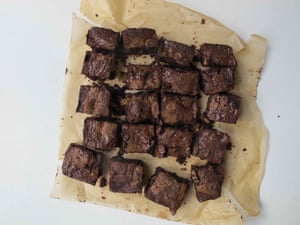
Deb Perelman brownies.
Deb Perelman brownies. Photograph: Felicity Cloake for the Guardian

The extras

Perelman, Lewis and Poliafito and Kimber all add vanilla to the batter, which, although not absolutely necessary, works very well with the flavour of the caramel. Also very much optional, but a great improvement as far as I’m concerned, is a sprinkling of toasted nuts to add a little crunch to proceedings. Nuts and caramel, and nuts and brownies are both classic combinations, so, although none of the recipes I try includes them, to leave them out seems like a dereliction of gastronomic duty. I favour pecans, but peanuts, almonds or even walnuts would work – or indeed none of the above, as you prefer. They will be delicious, whatever you add.

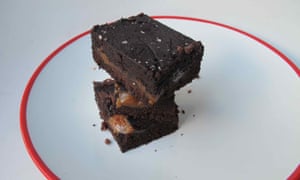
Perfect salted caramel brownies.
Perfect salted caramel brownies. Photograph: Felicity Cloake for the Guardian

Makes 25

200g very dark chocolate, as dark as you can find
250g unsalted butter
250g caster sugar
3 large eggs, lightly beaten
1 tsp vanilla extract (optional)
120g plain flour
½ tsp baking powder
Pinch of salt
100g pecans, or nuts of your choice (optional)

For the caramel

110g caster sugar
55g butter
4 tbsp sour cream
½ tsp flaky salt

Start by making the caramel. Line a plate or shallow bowl with lightly greased baking parchment. Melt the sugar in a medium pan over a medium-high heat until a rich amber, stirring occasionally to break up chunks. Take off the heat and stir in the butter, followed by the cream and salt, until melted. Pour on to the lined plate and chill or freeze until solid, but still soft enough to scoop (about 40-55 minutes).

Meanwhile, melt the chocolate in a heatproof bowl set over, but not touching, a pan of simmering water (or use a microwave). Allow to cool slightly, stirring occasionally. Heat the oven to 180C/350F/gas mark 4, and line a 23x23cm baking tin with baking parchment. Toast the nuts, if using, in a dry pan until fragrant, then roughly chop.

Once the caramel is almost ready, beat the butter and sugar together until light and fluffy. With the mixer still running, gradually add the eggs, beating well between each addition to ensure they are thoroughly incorporated before pouring in any more. Leave mixing on a high speed for 5 minutes until the batter has a silky sheen, and has increased in volume.

Remove the bowl from the mixer, and gently fold in the melted chocolate and vanilla with a large metal spoon, followed by the sifted flour, baking powder, salt and nuts.

Spoon half the mixture into the tin and make about 8 small divots on its surface then spoon generous blobs of caramel into them, reserving a quarter for the top. Spoon on the rest of the batter. Dot the remaining caramel over the top and bake for 30 minutes. Towards the end of the cooking time, prepare a sink with enough iced water to come halfway up the side of the tin.

Test the brownies with a skewer; it should come out sticky, but not coated with raw mixture. If it does, put it back into the oven for another 3 minutes, then test again. When ready, carefully lower the tin into the sink, then allow to cool before cutting into pieces and devouring.

Salted caramel brownies: too much of a good thing, or all your dreams come true? And is there anything that can’t be improved with the addition of salted caramel?

This article was amended on 19 April 2017 to change the lead picture.

In Italy, Easter is one of the biggest festivals of the year. Join in with these recipes for a traditional roast kid or lamb, rabbit with wild garlic and rhubarb and almond pudding In Italy, Easter is one of the biggest festivals of the year. Join in with these recipes for a traditional roast kid or lamb, rabbit with wild garlic and rhubarb and almond pudding

Easter outstrips even Christmas in importance in the Italian calendar. Carnevale marks the start of 40 days’ anticipation that culminates in a feast the like of which no amount of Lenten abstinence could prepare you for. My favourite centred on a multi-coloured chocolate bunny almost as tall as me.

Other popular treats are torta pasqualina filled with spinach and eggs, the “dove” shaped colomba, and many, many different types of fried sweet dough. There are perhaps even more Easter traditions in Italy than there are small towns. Almost all are delicious, but none especially light.

The River Café is always open on Easter Sunday, so instead my family sits down together on Saturday night or Easter Monday when we eat something special. Kid and goat is becoming easier to find at the butchers, so I included it. Rabbit, another favourite at our table, might also do. Cooked with wild garlic, olives and prosciutto, it stands up by itself

Usually I make pastiera at Easter, the ancient grain, candied fruit and ricotta tart from Naples scented with rosewater. It has a great tradition and pedigree, but this year it inspired a frivolous chocolate number instead. It is as densely moreish as the almond rhubarb pudding is daintily pretty, thus something for everyone. A recipe for a happy family gathering.

Traditional Easter roast with potatoes

This is very straightforward, delicious and, crucially, takes minimal effort. Cooking the meat uncovered and dry helps retain a welcome chew so while it is soft it doesn’t fall to pieces.

Serves 6
kid or lamb shoulder, off the bone, 1.5 kg
garlic 10 cloves, crushed
lemon 1
chilli 1, dried, crushed
rosemary
oregano or marjoram dried
fennel seeds 1 tbsp
potatoes 1.5 kg
olive oil
salt

Well ahead, preferably the day before, cut the meat into chunks, say eight. Cut the lemon into eighths and squeeze on to the meat adding the crushed garlic, chilli, loads of rosemary needles, a good pinch of oregano and the fennel seeds. Peel the potatoes, cut into 3cm chunks and mix with salt and a glug of oil. Leave the meat and potatoes to marinate.

Heat the oven to 120C/gas mark 6 and remove the potatoes from the meat. Roast uncovered, in a heavy tin with sides, for 90 minutes. Turn the oven up to 230C/gas mark 8 and turn the meat over. After 20 minutes cautiously remove some of the fat with a ladle, add the potatoes before turning over the meat again. Cook until the potatoes are golden – usually about another 40 minutes.

Rabbit with wild garlic

‘A favourite at our table’: rabbit with wild garlic.
‘A favourite at our table’: rabbit with wild garlic. Photograph: Jean Cazals for the Observer

This is full of the joys of spring. Adding the ingredients in stages keeps the dish fresh despite its long braising. If you can’t find wild garlic use regular, but add it early.

Serves 6
rabbit 1, farmed, jointed, about 1.5 kg
onion 1, small
celery stick 1
olive oil
parsley a few sprigs
wild garlic 15 leaves, or 6 peeled garlic cloves
carrots 5
black olives such as taggiasche, a handful
broad beans 500g, fresh, shelled (optional)
prosciutto 6 slices
white wine 200ml
salt and pepper

Thinly slice the onion and celery. Season the rabbit well and place, with a couple of tbsp of olive oil in a large frying pan. Scatter over the onion, celery, a few of the parsley sprigs, (the whole garlic cloves if using) and cover. I do this with baking paper and tin foil as I don’t have a large enough lid. Place over a medium heat until you smell it cooking – about 5 minutes – then turn down to the lowest heat and cook for 90 minutes, removing the lid and turning after 40 minutes. If the pan is dry, add a splash of water.

Peel the carrots, cut into small pieces and add to the pan with the olives and broad beans. Cover with the prosciutto, then the lid and cook for another 20 minutes. Remove the lid, add the white wine, more parsley and the garlic leaves and increase the heat. Cook till the wine is almost gone. Add fresh pepper before serving.

Whole grain and chocolate tart

‘Densely moreish’: whole grain and chocolate tart.
‘Densely moreish’: whole grain and chocolate tart. Photograph: Jean Cazals for the Observer

Pearled grain means that the hard husk has been polished and so is better suited to the purpose here.

Serves 10
For the pastry:
butter 150g, soft
wholemeal spelt flour 175g
white spelt flour 175g
icing sugar 100g
baking powder 1 tsp
egg 1
egg yolk 1

For the filling:
pearled whole spelt 80g
milk 600ml
cinnamon 1 stick
lemon peel from 1 lemon, shredded
dark chocolate 200g
caster sugar 80g
plain flour 50g
eggs 3, separated
salt

Make the pastry by rubbing the butter into the flour, baking powder and icing sugar to resemble crumbs. Then combine the egg and bring together to form a dough. Wrap and rest for at least an hour.

Soak the grain for several hours. Bring the grain and milk to the boil in a heavy pan with the cinnamon stick and lemon peel. Simmer on a low heat until cooked and thick. This may take as long as 2½ hours. Remove the cinnamon, break the chocolate in and stir off the heat until melted. Stir in half the caster sugar, the flour and egg yolks. Whisk the egg whites with the remaining sugar and fold through.

Heat the oven to 175C/gas mark 3.5. Roll two thirds of the pastry and line a 25cm tart shell with it. Fill to the top with the grain and chocolate. Roll the rest of the pastry, cut into strips and crisscross over the top. Brush the pastry with milk and sprinkle over a pinch of sea salt. Feel free to skip this bit and use leftover pastry for jam tarts if you like. Bake for 35 minutes.

Allow to cool before serving.

Rhubarb and almond pudding

‘Brilliantly quick’: rhubarb and almond pudding.
‘Brilliantly quick’: rhubarb and almond pudding. Photograph: Jean Cazals for the Observer

This is a brilliantly quick dessert, but it doesn’t keep. Prepare while cooking everything else, remove from the oven just before sitting down and it will be perfect in time for pudding. Use a large pan to keep the batter shallow.

Serves 2
pistachios 20g
almonds 20g, with skins
rhubarb 200g, thin, cut into 3cm pieces
butter 30g, unsalted
egg 1
light soft brown sugar 50g, plus extra for the rhubarb
salt
orange ½, zested
almond milk 75ml, or whole milk
almonds 50g, finely ground
cinnamon stick a few flakes

Heat the oven to 180C/gas mark 4. Butter a 25cm cake tin. If the pistachios have skins on, pour boiling water over them and stand for 10 minutes, then peel. Roughly chop with the whole almonds. Dust the rhubarb with sugar and scatter in the tin. Melt the butter. Whisk the egg with the sugar and salt, and then the zest, milk, ground almonds and butter. Pour over the fruit and top with the other nuts and small flakes of cinnamon. Bake for 25-30 minutes. It should stay slightly wobbly.

Joe Trivelli is joint head chef at the River Café

Correction: the Traditional Easter roast with potatoes contains a temperature error in the method. The oven should be heated to 120C/gas mark 6 before being increased to 230C/gas mark 8

Celebrate Easter with a chocolate treat that’s strictly for grown-ups Celebrate Easter with a chocolate treat that’s strictly for grown-ups

Why let children have all the fun at Easter? Use ready-made chocolate liqueur or make your own (see below). Serves one.

For white chocolate liqueur (makes about 500ml)
350g white chocolate
125ml milk
75gr caster sugar
350ml vodka
35ml gin
35ml white chocolate liqueur
2 tsp sugar syrup (1:1 sugar:water)
3 dashes lemon bitters
25ml lemonade
1 lemon leaf, to garnish (optional)

If you’re using shop-bought white chocolate liqueur, just skip this paragraph. Put a bowl over a large pan of simmering water (do not let the base of the bowl come into contact with the water), add the white chocolate and stir until melted. Add the milk and sugar, and stir to dissolve. Take off the heat, stir in the vodka and leave to cool. Transfer to a suitable container and freeze for a few hours, then pass through a fine sieve, to remove any solids. Decant into a sterilised jar or bottle, and seal.

Put the gin, liqueur, syrup and bitters in a shaker, fill with ice and shake. Double strain into a highball glass over fresh ice, top with lemonade and garnish.

Rich Woods, head of spirit and cocktail development, Duck & Waffle, London EC2.

Spring has sprung, so gorge on those gorgeous green spears while their short season lasts. But don’t just stick to boiled or steamed and buttered: turn them into soup and risotto, too Spring has sprung, so gorge on those gorgeous green spears while their short season lasts. But don’t just stick to boiled or steamed and buttered: turn them into soup and risotto, too

The arrival of the first asparagus each year means spring is in full swing, which is a boon for the smart cook. The markets will fill with wave upon wave of summer garlic, peas, courgettes, beans, berries, aubergine, tomatoes and so on, an ever-changing carnival of produce that goes on until the end of the year. The variety is brilliant. It’s worth going to a market even it’s only once a month, just for the sheer pleasure of seeing all this laid out in front of you. And if you’re clever about what you buy, and when, markets can be cheaper than supermarkets, too. Here, I am making the most of asparagus with a delicate chilled soup scented with dill and mint, and as the star of the show in a rich, sumptuous risotto.

Spring asparagus and yoghurt soup

I like to serve this light soup very cold, but if there is still a nip in the air, there’s nothing to stop you from warming it through. Serves four.

700g asparagus
30g butter
1 tbsp olive oil, plus extra for drizzling
5 spring onions, trimmed and chopped
2 leeks, washed, trimmed and chopped
Flaky sea salt and freshly ground white or black pepper
1 litre chicken (or vegetable) stock, or water
1 small handful fresh dill leaves, chopped, plus extra for serving
1 small handful picked mint leaves, washed and roughly chopped
125g natural yoghurt, plus extra to serve

Snap off the woody ends of the asparagus stalks – they should snap easily at the right point, about an inch from the end of the stalk – then cut the spears in half or into thirds.

Heat the butter and oil in a large pot over a medium flame. Add the spring onions, leeks and half a teaspoon of flaky sea salt (or less of fine sea salt), and cook for about five minutes, until the vegetables start to soften. Add the asparagus and cook for a further five minutes, then pour in the stock or water. Season with freshly ground pepper (I like white in this soup, but that’s just a personal preference), bring to a gentle simmer, and leave to bubble for 10-15 minutes, until all the vegetables are tender.

Transfer the soup to a blender or food processor, add the fresh herbs and whizz completely smooth: you’ll probably have to do this in two or three batches, so start with as many of the solids as possible, to ensure a smoother soup. Add the yoghurt to the last batch of soup and whizz smooth. Combine all the batches of processed soup, and season to taste: remember that the seasoning will taste more muted once the soup is cold. Transfer to the fridge and leave to chill thoroughly.

Serve in bowls, chilled ideally, with a teaspoonful of Greek yoghurt, a sprinkling of finely chopped dill and, if you like, a cube of ice. Alternatively, reheat the soup gently, taking care it doesn’t come to a boil, otherwise the yoghurt will curdle, and serve in bowls topped as for chilled, or with a slick of olive oil and the finely chopped dill.

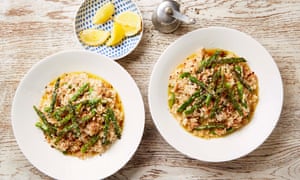
Asparagus and brown butter risotto with mace and brown shrimp

Thomasina Miers’ asparagus and brown butter risotto with mace and brown shrimp.
Thomasina Miers’ asparagus and brown butter risotto with mace and brown shrimp. Photograph: Louise Hagger for the Guardian. Food styling: Emily Kydd. Prop styling: Jennifer Kay

The addition of the shrimp turns this nutty, silky risotto into something altogether more luxurious. Serves six.

2 bunches asparagus
1.3 litres chicken stock
60g butter
Sea salt and freshly ground black pepper
2 tbsp extra-virgin olive oil
2 onions, peeled and finely chopped
¼ nutmeg
500g risotto rice
200ml dry vermouth (or white wine)
50g parmesan, plus extra to serve
200g brown shrimp
1 pinch Turkish chilli flakes or cayenne pepper (optional)
1 lemon, cut into wedges

Snap the woody stems from the base of the asparagus spears as in the soup recipe, then cut them at an angle into 2- to 3cm-long pieces. Put the stalks and tips in separate bowls and steam both for about three minutes, until al dente.

Heat the stock in a small pan and keep warm. Meanwhile, melt the butter in a large casserole, season generously, and cook until the solids are a deep, dark brown and smelling nutty. Pour all but a tablespoon of the melted butter into a cup; you’ll be using this later. Add the oil to the casserole, then stir in the onion and season with a pinch of salt and pepper and all the grated nutmeg. Fry the onion until soft and translucent, about 10 minutes.

Add the rice to the pot and stir for about four minutes, until all the grains are coated in the fat and turn translucent. Turn up the heat and add the vermouth, stirring until all the liquid has been absorbed, then pour in a ladleful of hot stock and stir. Once the stock has been absorbed, add another ladle, and repeat, stirring, until all the stock is used up; this should take 20-25 minutes in total. Add the steamed asparagus stalks to the risotto with the final ladleful of stock.

Heat a small frying pan, add a tablespoon of the reserved nutty butter and fry the asparagus tips until coloured all over.

When the rice is tender, take it off the heat and stir in the parmesan and shrimps, adding a little more of the butter. Season generously, cover with a lid or foil, and leave to rest for five minutes. Spoon into shallow bowls and top with the remaining butter, the fried asparagus tips, some extra parmesan, a few pinches of chilli or a good grind of pepper, and serve with a lemon wedge.

And for the rest of the week…

You’ll probably have leftover mint and dill after making the soup: chop them finely and store in white-wine or raspberry vinegar sweetened with brown sugar and salt, to make a delicious dressing for grilled lamb chops or roast leg of lamb. And if you’ve got excess risotto, make arancini. Mould the risotto into small balls, stuffing each with a little goat’s cheese or mascarpone, then breadcrumb and fry in butter until crisp. With a crisp, green salad, that’s a gorgeous light lunch or supper.

Small changes to familiar flavours will encourage kids to open up to a more exciting range of recipes. Try a toddler friendly tagine and build-your-own tacos to spice things up Small changes to familiar flavours will encourage kids to open up to a more exciting range of recipes. Try a toddler friendly tagine and build-your-own tacos to spice things up

Before I became a mum, I was probably quite sanctimonious about feeding kids. I envisaged my own children sipping green smoothies every morning and thought that if you exposed kids to a food often enough, they would eat it.

Not true. Little ones have likes and dislikes as much as adults do, and with their super-sensitive palates, those preferences are just amplified. And that’s before you even think about texture. Texture, for kids, seems to me to be key. Some, my son included, like things raw and crunchy, others like everything liquidised. Just like adults, it’s all totally down to the individual you are cooking for.

I have spent a long time cooking for kids of all ages. When I worked for Jamie Oliver, we spent six months helping the brilliant Kidbrooke school dinner ladies transform their school’s offerings. When we tried to get the kids to be more adventurous, it struck me that the key was to make small changes – not leaping from plain pasta to moussaka in one go, but to do it in baby steps: pasta with tomato sauce, then pasta with some aubergine, until you get there. After all, eating is learning.

The single most powerful thing I have found when trying to get my son to try new things is for us all to have a meal together, around the table. It’s not a groundbreaking piece of advice, I know, and it’s not always possible, but when we do manage it, he is more experimental, eating off our plates.

These are two dinners that I plan to make as he grows up. Both recipes start with a gentle base (which should be suitable for most kids from nine months up) with a few add-ons for older or more adventurous children – also adults.

I think that’s important when feeding a family – a meal with a bit of interaction, and some choice, so that each member of the family feels in some way in control of their choices. Customisable food. I’m not suggesting that you cook this way every night – cooking is my day job and I still don’t manage that! But do get your kids involved as much as you can: even if it’s just buttering some toast or spreading tomato sauce on a pizza base. It’s all part of the learning.

Toddler-friendly tagine (main picture)

This tagine – the gentle base – is popular with little ones thanks to the natural sweet notes from the dried apricots. I have suggested using some salt here during the cooking process – for small kids I would leave it out. For older kids, try serving the dish with the optional add-on: a garlicky herb smash. They might also enjoy helping you bash the seeds from the pomegranate – just don’t do so near a white wall.

Serves 2 adults and 2 hungry kids
For the tagine
1 tbsp olive oil
1 onion, diced
2 garlic cloves, crushed
½ tsp sweet paprika
1 tsp ground coriander
1 cinnamon stick
3 sweet potatoes, cut into bite-size chunks
2 carrots, cut into bite-size chunks
400g tinned chickpeas
400g tinned chopped tomatoes
100g apricots
Flaky sea salt

For the herb smash (optional)
A small bunch of fresh coriander
A small bunch of fresh flat-leaf parsley
2 garlic cloves, peeled
A handful of green olives, pitted
1 preserved lemon
2 tbsp olive oil

For the couscous
200g wholewheat giant couscous
Extra virgin olive oil
1 pomegranate, seeds removed

1 Heat the olive oil in a large, heavy-based saucepan or casserole dish. Add the onion, and cook until it has turned translucent. Add the garlic and spices, and stir until you can really smell their aroma, then throw in the sweet potatoes and carrots.

2 Stir to coat the root vegetables in the spices, then tip in the chickpeas, chopped tomatoes, apricots and add up to 400ml of water – enough just to coat the vegetables. Season with salt to taste, if you like, and cook until the root vegetables are just tender, which takes around 25 minutes.

3 While the tagine is cooking, prepare the herb smash. Finely chop the herbs and garlic (you could use a food processor if you like). Roughly chop the olives and preserved lemon and add to the herb mix. Add the olive oil and taste: you may like to add a little salt, but go carefully as the olives and preserved lemon will be quite salty.

4 When you’re nearly ready to eat, cook the couscous. Bring a large pan of salted water to the boil, then add the couscous in a steady stream. Cook on a rolling boil for 6-8 minutes, until tender. Drain really well and drizzle with a little olive oil. Stir through the pomegranate seeds.

5 Serve the tagine on a pile of pomegranate couscous with a dollop of herb smash on top for adults and adventurous kids to dig into.

Family tacos

In my experience, the most successful family meals are when there are lots of things in the middle of the table for little hands to reach and grab for – the more colour the better. The salsa in this recipe is quite spicy and is intended to add some punch for the more adventurous palate, so I suggest splitting the salsa into spicy and non-spicy, so everyone is happy.

family taco recipe
‘I have suggested adding a little salt during cooking; for young children I would leave out the salt, chilli and any green leaves,’ says Anna Jones. Photograph: Issy Croker for the Guardian

Serves 2 adults and 2 kids
For the flatbreads
400g white spelt flour (you could use plain flour too)
1 tbsp baking powder
½ tsp flaky salt
350g natural yoghurt

For the slaw
½ spring cabbage
8 radishes
1 apple
1 carrot
Juice and zest of 1 lime
100ml natural yoghurt
Flaky sea salt

For the salsa (optional)
2 big handfuls cherry tomatoes
½ bunch spring onions, finely sliced
1 red chilli (optional)
1 tsp chipotle paste, or to taste

For the filling
2 tbsp olive oil
½ bunch spring onions, finely sliced
1 tsp ground cumin
½ tsp ground coriander
½ tsp ground cinnamon
2 x 400g tins cannellini beans, drained
A bunch of coriander, to finish (optional)

1 First, make the flatbread dough. Combine the flour, baking powder and salt in a large bowl, then stir in the natural yoghurt. Mix well until everything has come together into a ball, then get in there with one hand and knead until you’ve got a smooth and slightly tacky dough. If it feels like it is at all dry (this will depend on your flour), you can add up to 50ml of cold water, a little bit at a time, until the dough comes together nicely. Cover with a clean tea towel, then set to one side until you’re ready to cook the flatbreads.

2 Now, make the coleslaw. Slice the spring cabbage and radishes really finely, then combine them in a large mixing bowl. Shred the apple and carrot using the coarse side of a box grater, then add them to the bowl of cabbage and radishes along with the lime zest, half of its juice and a pinch of salt. Add the natural yoghurt. Stir really well until everything is evenly coated, then set aside.

3 Next, make the salsa. Cut the cherry tomatoes into quarters, and slice the spring onions. Add these to a little bowl, squeeze over the juice from the other half of the lime (left over from making the coleslaw). Divide the tomato mixture in half, then reserve one portion for the kids. Finely slice the red chilli and add this to the adult salsa bowl along with the chipotle paste and a little pinch of salt.

4 For the filling, heat the oil in a large pan and add the spring onions. Cook until they are soft and a little coloured, then add the spices. Stir until you can really smell their aroma, then tip in the beans, crushing them a little with your spatula as you stir. Add a pinch of salt, and a splash of water if the beans seem at all dry. Keep the filling warm while you cook the flatbreads.

5 When you’re ready to eat, prepare your flatbread rolling station, as close to the stove as safely possible. Sprinkle the worktop with flour, then tip out your dough. Divide the dough in two, then divide the first half into six pieces. Heat a large nonstick frying pan until it’s very hot, then roll out the first piece of dough until it’s very thin and about 20cm across. Carefully lift it into the pan and cook for around a minute on each side, or until it’s lightly coloured and the surface is littered with bubbles. Repeat with the remaining five small pieces of dough, then divide the second half into six pieces and repeat with those.

6 Serve everything in bowls on the table for people to help themselves. Keep the warm flatbreads wrapped in a tea towel to help them retain their heat, arrange alongside the beans, slaw, salsa and a bowl of coriander leaves for a final sprinkling.

Tips to get kids to eat more veg

One thing I am often asked is how to get kids to eat more veg. I am no expert, but here is what I have learned:

  • Lead by example: if your kids see you eating veg it will be normal to them.
  • Try offering a rainbow of veg and a favourite dip, such as hummus, before the main meal – unexpected vegetables like radishes, celery and olives are surprisingly successful in our house.
  • Keep meal times casual, happy and breezy: stress around food will be picked up by everyone around the table.
  • If all else fails, cook lots of veg down into a tomato sauce and put it on everything
  • Anna Jones is a chef, writer and author of A Modern Way to Eat and A Modern Way to Cook (Fourth Estate) annajones.co.uk; @we_are_food

Traditional roast lamb has its place, but try something new this Easter by looking to China, north Africa and Thailand for inspiration Traditional roast lamb has its place, but try something new this Easter by looking to China, north Africa and Thailand for inspiration

Lamb, for all its associations with anchovy, rosemary, garlic and the Easter weekend, is a wonderfully non-denominational meat. As much as I thought I was going to stick with tradition this week, I’m tickled as pink as a just-cooked fillet with how global (and, therefore, pan-religious) my recipes for lamb are. There’s a salad that takes inspiration from Thai beef salad, with the meat rare and cut thin and the salad fresh and fragrant; a shepherd’s pie with a north African twist from the addition of harissa, olives and dried apricots; and a lamb braise that uses all sorts of Chinese cooking staples.

The food we eat at Easter is, of course, symbolic and meaningful. There’s a reason and a story behind the traditions of our tables this weekend: the 11 balls of marzipan on top of simnel cake, say, the mark on top of a hot cross bun and the sacrifice of the lamb. But we also all have our own traditions and stories that we create with family and friends. These are the traditions we return to simply because it’s lovely to get together to celebrate over the long weekend, and lamb is a particularly lovely thing to do that with.

Spiced lamb shepherd’s pie with butterbean crust

A north African take on the classic dish, with a butterbean tahini mash topping instead of a potato one. You can assemble the pie up to two days ahead, and refrigerate, in which case add five to 10 minutes to the baking time, to allow for it being cooked from cold. Serves four generously.

90ml olive oil
3 garlic cloves, peeled and crushed
3 banana shallots, peeled and thinly sliced
600g minced lamb
2 tsp cumin seeds
3 tsp ground allspice
Finely grated zest of 2 lemons
Salt and freshly ground black pepper
3 tbsp tomato paste
3 tbsp rose (or regular) harissa
100g dried apricots, quartered
280ml chicken stock
220ml white wine
80g pitted green olives, cut in half lengthways
670g cooked butterbeans (ie, 3 tins’ worth, drained; alternatively, soak 400g uncooked beans in water overnight with a teaspoon of bicarbonate of soda, drain and boil until cooked)
3 tbsp tahini paste

In a large, heavy-based pan for which you have a lid, heat three tablespoons of oil on a medium-high heat, then saute the garlic and shallots for about five minutes, stirring often, until soft and golden. Turn up the heat to high, then add the lamb, cumin, allspice, half the lemon zest and half a teaspoon of salt. Fry for five minutes or so, stirring every now and then, until browned all over, then add the tomato paste, harissa and half the apricots. Fry for two minutes more, then add the stock and wine, turn down the heat to medium, cover and leave to simmer for 30 minutes.

Once cooked, set aside the meat to cool, then stir in the olives and remaining apricots, and spoon the stew into a 20cm x 25cm high-sided ovenproof dish and refrigerate for at least half an hour. This will firm it up, making it easier to spread the mash on top.

Heat the oven to 180C/350F/gas mark 4. Combine the butterbeans in a large bowl with the remaining lemon zest, two tablespoons of olive oil, the tahini paste, three-quarters of a teaspoon of salt and a generous grind of black pepper, then mash with a potato masher – the beans don’t need to be totally smooth, just spreadable.

Spread the butterbean mix evenly over the top of the lamb, then make shallow dips here and there in the surface of the mash with the back of a tablespoon. Drizzle over the remaining tablespoon of oil and bake for 30 minutes, until nicely coloured and bubbling. Leave to rest for 10 minutes, then serve.

Easy braised lamb

As the name suggests, this is a cinch of a one-pot dish. Pretty much all the work is done in the oven, but it does require a bit of organisation to marinate the meat in advance. The joy of doing all the prep a day ahead is that, when it comes to serving, this feels like an instant supper. The fresh coconut adds a gorgeous texture, but the dish is still wonderful without. Serves six.

1 tbsp cumin seeds
¾ tsp Szechuan peppercorns
½ tsp ground ginger
1kg diced lamb shoulder

3cm piece fresh ginger, peeled and finely grated
1 tbsp chilli flakes
2½ tbsp rice vinegar
2 tbsp soy sauce
20g dark brown soft sugar
2 tbsp olive oil
2 aubergines, cut into 3cm chunks
15 spring onions, trimmed and cut into 4cm lengths
2 red peppers, core and seeds removed, then cut into 6 wedges each
Salt
100g coconut milk
50g fresh coconut (ie, the flesh of ¼ small coconut), coarsely grated, optional
10g coriander leaves, whole or roughly chopped
1 lime, cut into 6 wedges

Put the cumin, peppercorns and ground ginger in a spice grinder, then blitz fine. Put the lamb in a large bowl, add the spice mix, fresh ginger and chilli flakes, then rub all over to coat, cover the bowl and marinate in the fridge for at least two hours, and ideally overnight.

Heat the oven to 160C/320F/gas mark 2½. Add the vinegar, soy sauce, sugar, a tablespoon of olive oil and half a teaspoon of salt to the lamb bowl, toss to combine, then tip the lot into the base of a large, 30cm x 35cm roasting tin.

In a bowl, combine the aubergines, spring onions, peppers, remaining tablespoon of olive oil and a quarter-teaspoon of salt, then spread the vegetables on top of and around the lamb. Cover tightly with aluminium foil, then bake for two hours, stirring once; add a little water if the braise starts to look a bit dry. After the two hours are up, remove the foil, bake for a further 30 minutes, then stir in the coconut milk.

Divide the stew between six plates or bowls, and sprinkle over the fresh coconut, if using, and coriander. Serve with steamed rice and a wedge of lime.

Grilled lamb salad with pomegranate and buckwheat

Yotam Ottolenghi’s grilled lamb salad with pomegranate and buckwheat.
Yotam Ottolenghi’s grilled lamb salad with pomegranate and buckwheat. Photograph: Louise Hagger for the Guardian. Food styling: Emily Kydd. Prop styling: Jennifer Kay

Serves four as a first course, or two as a light lunch.

1 aubergine, cut into 5cm x 3cm chunks
75ml olive oil
Salt and freshly ground black pepper
100ml pomegranate juice (ideally one that is 100% juice, such as the Pom brand)
2 limes, 1 juiced to get 1 tbsp juice, the other quartered, to serve
1½ tsp light soy sauce
½ small garlic clove, peeled and crushed
400g lamb neck fillet, cut widthways into 6cm-long pieces
100g pomegranate seeds (the seeds from 1 medium pomegranate)
½ red onion, peeled and cut into 3mm-thick slices
30g mint leaves
40g coriander, leaves and thin stalks (don’t use the thick stalks here)
1½ tsp kasha (aka roast buckwheat), optional

Toss the aubergine in a medium bowl with three tablespoons of oil, a quarter-teaspoon of salt and a good grind of pepper. Heat a large nonstick frying pan on a medium-high heat, then fry the aubergine for eight to 10 minutes, turning occasionally, until golden-brown all over. Transfer to a plate lined with kitchen towel and leave to cool.

For the dressing, in a small bowl whisk the pomegranate juice, lime juice, soy sauce, garlic and a quarter-teaspoon of salt.

Toss the lamb in a bowl with the remaining two tablespoons of oil, half a teaspoon of salt and a generous grind of pepper.

Put a medium griddle pan on a high heat and ventilate the kitchen. Once the pan is very hot, turn down the heat to medium and grill the lamb (and any juices and oil from the bowl) for eight to 10 minutes, turning regularly, until charred all over. Transfer to a board, cover with foil and rest for 10 minutes, then cut into 0.5cm-thick slices (you’ll need a really sharp knife to get it this thin).

Put the aubergine, pomegranate seeds, onion and herbs in a large bowl with three-quarters of the dressing and toss, taking care not to crush the aubergine pieces, then divide between four (or two) plates. Arrange the lamb on top, so that half the salad is visible, then spoon over the remaining dressing. Sprinkle with buckwheat, if using, crushing some between your fingers and leaving some whole, and serve with a wedge of lime.

Yotam Ottolenghi is chef/patron of Ottolenghi and Nopi in London.

Warm weather means picnics, so Kate Young recreates a recipe enjoyed by Ratty and Mole in Kenneth Grahame’s classic children’s tale Warm weather means picnics, so Kate Young recreates a recipe enjoyed by Ratty and Mole in Kenneth Grahame’s classic children’s tale

‘There’s cold chicken inside it,’ replied the Rat briefly; ‘coldtonguecoldhamcoldbeefpickledgherkinssaladfrenchrollscresssandwichespottedmeatgingerbeerlemonadesodawater——’

‘O stop, stop,’ cried the Mole in ecstasies: ‘This is too much!’

The Wind in the Willows, Kenneth Grahame

---

Last weekend, I found myself walking along a canal in the English countryside. Pastel-hued blossoms covered the trees, the hills smelt of wild garlic, and summer was undeniably on its way. On that walk, with my face turned towards the sun, it was good to feel that winter had retreated.

I have written often of my love for the cold, the grey skies, the endless sartorial options. But, as Virginia Woolf said about spring: “I enjoy the spring more than the autumn now. One does, I think, as one gets older.” I feel, this year, as though this may be true. I have welcomed the brighter days and warmer weather with more enthusiasm than before. I realise that it’s early days, but I’m excited about the months to come.

This summer, my as-yet-unpublished book will be spending time in the darkness, in boxes, as it makes its slow way back across the sea to England. Unable to tinker with it any further, I have taken on catering commissions, supper clubs, and writing new things. I’m also going to picnic – I spent far too much of last summer indoors; this summer, I am going to soak up the sun while I can.

Over the Easter holidays, as a nanny I’ve been spending my days supervising maths projects, gymnastics routines, epic games of Hide & Seek, and mocktail experiments. This calls for effortless cooking; like a roasting dish placed in a low oven as the breakfast pancakes are being flipped, the contents gently pulled at with forks hours later, before being served for lunch. This is the way I like to eat in the summer: a board with little jars of pickles, a wedge of cheese, a twisted parcel of rich, salty butter. These are all perfect partners for rich, full-flavoured beef. I’ll be making this recipe again, many times, in the months to come.

Potted beef from The Wind in the Willows
Photograph: Kate Young of The Little Library Café

Potted Beef

Serves 4 on a picnic

Ingredients
450g shin beef, in 2cm chunks
10 sprigs thyme
1tbsp mustard seeds
8 anchovy fillets
2 garlic cloves, crushed
Generous grinding of black pepper
100g butter

Serve with
Good salted butter
Baguette
Jar of cornichon

Equipment
Roasting dish that fits your beef in one closely packed layer
Aluminium foil
Mortar and pestle
Two forks
Jar, for storage

1. Preheat the oven to 150C. Line the tin and lay the beef in a single layer over it. Pull the thyme leaves from the stalks and crush the mustard seeds. Sprinkle them over the beef, then add the whole anchovies and the garlic, and season with pepper.

2. Cut the butter into thin slices, and cover the beef with it. Tightly seal the top of the roasting dish with foil, and place in the oven.

3. Roast for at least four hours, checking occasionally to ensure the beef is not drying out. Add a splash of water, wine or stock if it is browning on top at any point. Continue cooking until the meat pulls apart with gentle pressure from a fork.

4. Allow the beef to cool a little, then place the pieces in a bowl and pull apart. Lubricate the meat with a little of the buttery, anchovy-rich liquid from the roasting tray, and squash the meat into a jar. If you’re going to eat on a picnic within the next day, you can store it like this. Alternatively, it will keep for a few days in the fridge, with a layer of clarified butter on top.

This month, Honey & Co’s Itamar Srulovich tells us what it’s like being the only male cook in his restaurant group, Zoe Adjonyoh introduces us to her Ghana kitchen, and Jeremy Lee taste tests teas and coffees This month, Honey & Co’s Itamar Srulovich tells us what it’s like being the only male cook in his restaurant group, Zoe Adjonyoh introduces us to her Ghana kitchen, and Jeremy Lee taste tests teas and coffees

I had to fight to be allowed to cook at school. It was pretty much unheard of to give up Mr Oakley’s woodwork lessons for a day in the kitchen. The lone lad in a class full of girls. Forty-five years on, I am still one of the few male cookery writers in a mostly female profession (most other male food writers are professional chefs or restaurant reviewers). In this issue of OFM, we meet Itamar Srulovich from the wonderful Honey & Co, who tells us what it’s like to be a male cook in a restaurant group whose senior staff are mostly women. How different is the working environment? Apparently, it’s less egotistical for a start … well, there’s a surprise.

One of the most unforgettable days I have spent behind a stove was with Ghanaian Zoe Adjonyoh, shopping in Ridley Road market in east London, then going back to her home and cooking and eating with her.

I love days spent with other cooks. We forgot the BBC Eating Together film crew peering over our shoulders and just rolled up our sleeves and chopped, stirred and gossiped, making spice pastes and frying plantains, then laying the table for her friends who joined us for dinner.

I remember being at first shocked at the amount of chilli we used, and later pleasantly surprised at the warmth that exuded from her cooking rather than the expected unquenchable heat. She knew how to use it.

Zoe has since put together her family recipes in a new book, Zoe’s Ghana Kitchen, and for this issue she chats with Ruby Tandoh about cooking and their shared heritage.

On the subject of chillies, we have science writer Bob Holmes letting us into the secret of why some people are both psychologically and physiologically inclined to enjoy heat more than others.

We also have words from Susanna Reid and Grayson Perry, and the lovely Jeremy Lee takes on a taste test of tea and coffee.

As Roman markets heave with bright green broad beans, hands can be seen busy with the ritual of peeling them to eat with pecorino romano. Try them with herby rice and new-season lamb chops As Roman markets heave with bright green broad beans, hands can be seen busy with the ritual of peeling them to eat with pecorino romano. Try them with herby rice and new-season lamb chops

Like peeling roasted chestnuts, prising open shellfish, or simply flicking open a salted pistachio nut with your thumbnail, in Rome at this time of year peeling broad beans is part of a ritual – one as important as the taste. Important too is the cutting, or rather hewing, of the cheese with a small spade-like implement, tip of a knife, or the prongs of a fork, all of which create craggy pieces that seem to taste entirely different to a smooth-edged slice. The peeled bean and piece of cheese are then eaten together.

I first saw this ordinary ritual 12 years ago, soon after arriving in Rome. It was in a trattoria called Agustarello, a spare room of a place that lived up to my folklorish ideas about how a Roman trattoria should be: plain but welcoming, husband in the kitchen making the simple traditional food, formidable wife out front, their kids arriving back from school stroppy and in search of pasta, bread in a basket. A group of men at a table near me were brought a plate of broad beans in their pods and a partly excavated quarry of craggy white cheese. They began podding and hewing, their arms crossing in much the same way as their conversation, then eating beans with cheese, each in their own idiosyncratic way: the two together, beans first then cheese, cheese first then (double peeled) bean.

I hoped I might be brought the same thing, but wasn’t, not least because I was already finishing my meal. I looked for an explanation on a menu, but didn’t find one, and left before I really understood. In time though, I learned this is a Roman spring ritual, digging thumbs into the velvet-lined pod then unzipping it in order to eat the new season broad beans with Rome’s favourite cheese – black-wax encased, sheep’s milk pecorino romano. The combination of bright green beans: small, tender, sweet and tasting like pure chlorophyll and buttery wax, contrasting with the sharp, creamy cheese is a triumph.

It is not a habit confined to trattorie. When the air is filled with spring and the market with great heaps of broad beans, cheerful and cheap as chips, everyone does it – whether at a trattoria or at home, in a park or field. Fave e pecorino is a combination enjoyed for Easter breakfast with enriched bread and a salami studded with great nuggets of fat called coralina, for the picnic on Easter Monday, then again on the first of May, when many head into the countryside for a picnic and the pecorino sweats under the midday sun. It is a ritual full of symbolism for Romans who consider fava beans harbingers of spring – a custom that reminds us that it isn’t just what you eat, but how.

It is also a habit that travels happily – to Dorset where my parents live, for example, where local broad beans are a treat with sharp, local cheddar.

As the season progresses, broad beans, like people, age, their skin thickening, the sugar turning to starch so that tender tiddlywinks become thick buttons that need double peeling, their opaque coat popping off. For now, though, you can eat the whole bean.

In Rome, broad beans are part of another much-loved Roman dish called vignarola, a spring vegetable stew of artichokes, peas, beans, lettuce and onion braised in lots of olive oil. They are also stewed with prosciutto, made into a salad with thinly sliced fennel, or tossed with olive oil and piled on toast spread thickly with ricotta.

The idea for today’s recipe came from Jessica Seaton’s delightful new book Gather, Cook, Feast. It was the page the book fell open on: rice loaded with herbs and broad beans, and the answer to the question “what shall we eat tonight?” You could use all sorts of herbs here. I used parsley and basil because it was what I had, but went out and bought some dill for a touch of fragrant aniseed, which isn’t to everyone taste, but is a bit of an addition if it is. You could also use a handful of fennel fronds. Whatever herbs you use, use lots and chop them finely – they are ingredients not flecks – and add them while the rice is hot, so they disperse their aromatic scent. I think butter is important. Like the olive oil, it dresses and brings everything together, but it also rounds and softens the edges – butters them up if you like. You could just use olive oil. Jessica suggests fish as an accompaniment. I am suggesting lamb. In Rome, lamb is generally sold younger (the cutlets are smaller and bashed out) and cooked quickly, alla scottadito, which means cooked in the style that burns your fingers – hinting at how best to eat them, ritual being as important as taste.

Rice with broad beans, herbs and lamb chops

If you don’t eat lamb, replace with slices of salty cheese or stir some cooked chickpeas through the rice.

Serves 4
1.2 kg broad beans in their pods, or 400g frozen ones, defrosted
A small bunch of flat-leaf parsley
A small bunch of basil
A small bunch of dill
450g long grain white rice
5 spring onions, finely chopped
45g butter
4 tbsp extra virgin olive oil
Salt and black pepper
2 lemons
4 large, or 8 small lamb chops

1 Pod the broad beans. Taste one: at this time of year they should be tender enough to eat without double peeling – it’s your choice. If you decide to, cover the beans with boiling water for a minute, drain, then refresh in cold water, at which point the opaque skins should pop off if you squeeze. If you are not double peeling, boil the beans in salted water for 3 minutes or until tender, drain and keep warm.

2 Pull the herb leaves from the stems. Chop the leaves finely.

3 Rinse the rice twice, then cook in plenty of boiling, well-salted water until tender but al dente. Drain and leave to steam dry in a colander for 5 minutes.

4 In a large frying pan, over a medium-low heat, fry the spring onions until soft. Meanwhile, cook the lamb chops on a griddle pan or under the grill, the way you like them.

5 Add the rice, broad beans, salt, pepper, a squeeze of lemon juice and the herbs to the spring onions, then stir until everything is well combined and glistening. Turn on to a warm serving platter.

6 Once cooked, pile the lamb on top of the rice along with wedges of lemon.

Rachel Roddy is an award-winning food writer based in Rome and the author of Five Quarters: Recipes and Notes from a Kitchen in Rome (Saltyard;) @racheleats