Our social:

Latest Post

Sunday, November 27, 2016

Five Christmas recipes from Nigel Slater

Potato pancakes, partridge pie and fig ice-cream terrine: dishes to make and eat any time over the Christmas season

Christmas is not one, but many meals. What is more, it seems to start earlier every year. Let’s begin the celebrations with a collection of recipes suitable for bringing a festive feel to any meal in the run-up to Christmas. Some of them are perfect for the day itself, a huge game and sausage meat pie, for instance, or a butternut and brussels sprout custard for those who don’t want to eat meat. Others are suitable as accompaniments or principal dishes. I have also suggested a big winter salad and an ice cream terrine that tastes of the essence of Christmas.

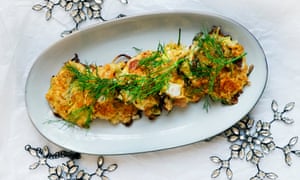
Potato and feta pancakes

I suggest these shredded vegetable patties as an accompaniment to the pie or custards below, but they will also work as a main course, or as a side order for cold turkey or ham.

Makes 6, serves 2-3
potatoes 250g
carrots 150g
olive oil 6 tbsp
eggs 2
feta 200g
dill 3 tbsp, chopped

Peel the potatoes and carrots and coarsely grate them. If using a food processor, use the coarse grating disc as you would for remoulade. Warm 3 tablespoons of the olive oil in a frying pan, add the grated vegetables and cook for 6-8 minutes until they have started to soften.

Beat the eggs lightly with a fork, just enough to mix yolks and whites then tip in the softened vegetables. Crumble the feta cheese into the mixture then add the chopped dill and black pepper.

Warm another 3 tablespoons of oil in the frying pan, then divide the mixture into 6 patties about the diameter of a digestive biscuit. Press them flat with a palette knife or the bowl of a spoon, then let them fry till pale gold. Turn each one over carefully and brown the other side. Remove with a palette knife or fish slice, drain briefly on kitchen paper then serve.

Green winter salad

Green winter salad.
Green winter salad. Photograph: Jonathan Lovekin for the Observer

Crisp, green and light, this leaf salad could be served after the pie below. I have kept it raw and simple, but you could also add salted almonds, a little goat’s or sheep’s cheese, or maybe some crisply fried bacon or pancetta.

Serves 4-6
brussels sprouts 200g
watercress 100g
little gem lettuce 1
young kale 2 large handfuls
young chard leaves a small bunch
avocado 1
sprouted seeds such as radish, beetroot or amaranth a handful

For the dressing
natural yogurt 6 tbsp
olive oil 6 tbsp
basil leaves 10g

Trim the base of each brussels sprout, remove the leaves layer by layer as far as you can. Cut the hearts in half and put them and the leaves in a large bowl.

Wash the watercress, remove the toughest stems and add the leaves and thin stalks to the sprouts. Halve the little gem lettuce lengthways, then trim the stalk and separate the leaves. Finely shred the kale leaves. Toss together the brussels sprouts, watercress, lettuce and kale and the young chard leaves.

Make the dressing: mix the natural yogurt and olive oil together with a small whisk or fork, then add the basil leaves, finely shredded, and season with salt and ground black pepper. Halve, stone and peel the avocado then cut the flesh into thick slices.

Transfer the leaves to a salad bowl, tuck the slices of avocado gently among the leaves, add any sprouting seeds you may like, then trickle over the dressing and toss gently before serving.

Pork and partridge pie

Pork and partridge pie.
Pork and partridge pie. Photograph: Jonathan Lovekin for the Observer

A sort of festive sausage roll, served as a generously filled pie with pieces of partridge (or, if you prefer, pigeon) breast tucked among the seasoned stuffing. To get a crisp bottom, make the pie on the removable base of a steel tart tin and bake on a preheated baking sheet. The bones from the little birds can be browned and simmered with bay and onion, then used as a stock with their leg meat and some pearl barley or small pasta such as orzo added to make a light but sustaining broth. The pie is good cold, too.

You will need a loose 24cm round tart tin base on which to cook the pie.

Serves 6
partridges 3
bay leaves 3
onion 1 small
red onions 2
carrots 3 medium
celery 2 ribs
olive oil 6 tbsp
butter 20g
smoked streaky bacon 8 rashers
thyme 8 sprigs
rosemary 2 busy sprigs
garlic 2 cloves
herby butcher’s sausages 8
ground allspice ½ tsp
ground cinnamon ½ tsp
ground mace ½ tsp
puff pastry 500g
eggs 2

For the sauce
clementine or small orange 1
dried cranberries 50g
dry marsala 150ml
redcurrant jelly 4 tbsp

Put the partridges into a deep saucepan then pour over enough cold water to cover the birds. Bring to the boil with the bay leaves and the small onion. Lower the heat to a simmer, cover with a lid, and let the partridges cook for 30 minutes.

Meanwhile, peel and finely dice the red onions, finely chop the carrots and cut the celery into small slices. Warm the olive oil and butter in a large, deep pan, stir in the onion, carrot and celery and cook for 5 minutes until the onion is translucent. Roughly chop the bacon and stir into the vegetables. Pull the leaves from the thyme sprigs and the needles from the rosemary. Chop the rosemary finely. Peel and finely crush the garlic then stir, together with the herbs, into the vegetables.

Remove the skins from the sausages then put the sausage meat into a large mixing bowl. Add the ground allspice, cinnamon and mace and season with salt and black pepper.

Remove the birds from their cooking liquor, let them cool briefly then remove the breast meat from the bones. It should come away easily. If not, slice it off the bones with a kitchen knife. Retain the remaining meat, bones and cooking liquor for stock.

Stir the softened onion and bacon mixture into the seasoned sausage meat, mixing thoroughly. I tend to use my hands here.

Cut off one third of the puff pastry and roll it to fit the base of a round 24cm tart tin with a little extra overlapping the edge. You can trim this later. Pile half the sausage and herb stuffing on top of the pastry, leaving 2cm or so of bare pastry round the edge. Smooth the surface level then place the 6 partridge breasts on top then add the remaining mixture, smoothing the top into a dome.

Roll out the second piece of puff pastry to fit generously over the meat. Beat the eggs in a small bowl then brush the edge of the bottom layer of pastry generously. Lower the second piece over the top then trim any overhanging pastry with a knife. Press firmly and pinch the edges to seal. Brush with beaten egg.

Use pastry trimmings to make leaves or holly berries with which to decorate your pie then press them into place. Brush with more beaten egg and rest the pie in the fridge for 20 minutes.

Meanwhile, set the oven at 200C/gas mark 6, placing a baking sheet in the oven to get hot. Carefully put the chilled pie, on its tart-tin base, on top of the hot baking sheet and bake for about 50 minutes till golden. Let the pie rest for 10 minutes before serving.

While the pie bakes, prepare the sauce. Cut the clementine in half and squeeze the juice into a saucepan. Remove and discard the flesh then cut the peel into very fine strips, as thin as you can. Add these to juice, then stir in the cranberries, marsala and jelly. Bring to the boil, immediately lower the heat then serve with the rested pie.

Brussels and butternut custards

Brussels and butternut custards.
Brussels and butternut custards. Photograph: Jonathan Lovekin for the Observer

You could use this squash bejewelled custard as a filling for a warm tart.

Makes 4
butternut squash 500g (peeled weight)
olive oil 3 tbsp
dried chilli flakes 2 tsp
brussels sprouts 200g
eggs 3
double cream 250ml
rosemary finely chopped, 1 tbsp
parsley finely chopped, 2 tbsp
butter a little for the ramekins

You will need four ramekins or small, ovenproof dishes approximately 9cm x 4-5cm deep.

Set the oven at 180C/gas mark 4. Cut the butternut into discs about 2cm in thickness, then cut each disc into quarters or sixths. Put the butternut pieces into a mixing bowl, pour in the olive oil then add the chilli flakes and a little salt and toss together gently, evenly coating the squash. Put the squash on a baking sheet in a single layer and bake for 30 minutes until pale golden brown and tender.

Meanwhile, cut the brussels in half and cook them for a couple of minutes in deep, boiling, lightly salted water until they are approaching tenderness. Drain and refresh in iced water. Break the eggs into a medium mixing bowl, pour in the cream and combine, then stir in the chopped rosemary and parsley and a little seasoning. Lightly butter the inside of the ramekins and place them on a baking sheet.

Divide the squash and drained brussels between the ramekins, then pour in the herb-flecked custard. Bake for 20-25 minutes till the custard is lightly set at the edges, a little wobbly in the centre.

Maple syrup and fig ice-cream terrine

Maple syrup and fig ice-cream terrine.
Maple syrup and fig ice-cream terrine. Photograph: Jonathan Lovekin for the Observer

If you have an ice-cream machine, churn the custard, syrup and yogurt mixture first, then stir in the chopped fig and chocolate at the end. To prevent the custard from curdling, keep the heat low and as it starts to thicken remove from the heat, pour into a chilled bowl over ice or in a sink of cold water and beat firmly and continuously until most of the steam has gone and the custard is smooth.

Serves 6
egg yolks 4
caster sugar 2 tbsp
double cream 450ml
vanilla extract a few drops
maple syrup 240ml
figs 3
dark chocolate 100g
thick, strained yogurt 200g
extra figs and physalis to serve

Put the egg yolks and caster sugar in the bowl of a food mixer and whisk till light and fluffy. Warm the double cream in a saucepan, switching the heat off just before it comes to the boil, then stir in the vanilla. Pour the warm cream onto the eggs and sugar and stir to mix. Rinse the saucepan then pour in the egg and cream mixture and return to a low to moderate heat. Warm the custard, stirring regularly, until it starts to thicken slightly on the spoon then pour into a cold bowl over ice or in a sink of cold water and stir or beat with a whisk to remove some of the heat. Leave to cool a little.

Pour in the maple syrup and combine. Chop the figs into small pieces, crushing them slightly as you go, then chop the dark chocolate into small thin shards with a large knife. Stir the yogurt, chopped figs and chocolate pieces into the custard then tip into a plastic freezer box and freeze for a good 4 hours or overnight. Turn the ice-cream out, then cut into large chunks and pile onto a chilled serving plate, perhaps with a few physalis and more slices of fig.

Tim Hayward is nostalgic for his nan’s corned beef, chips and peas

Fridge-cold sliced corned beef, mushy peas made from scratch and golden handcut chips piled high, served with Worcestershire sauce, are Tim Hayward’s taste of home

I moved around a lot as a kid and, oddly, the meal that most signifies home for me was eaten not at my house, but at my nan’s, in Fishponds, Bristol. It brings back feelings of warmth, love and belonging, but it’s extra-significant. I can clearly remember thinking about it when I wasn’t there, calling it to mind, re-experiencing and appreciating it. I analysed it, I considered it, even though I was about six. It was the start of a love affair with food that continues to this day.

We went to Nan’s on Saturday, and in the evening I’d change into my prized Bri-Nylon Man from Uncle pyjamas before tea and Doctor Who. I sat on the floor, with my back leaning on the rough uncut moquette of a wing chair, and stared, rapt, at the teak-effect box on which … well, let’s just say one of the earlier Doctors battled unconvincing aliens. I’ve never bought into the fond collective delusion about hiding behind the sofa: the monsters were always crap. That was the point.

Tea came on a tray, on thick china, and comprised a mound of mushed marrowfat peas, three slices of corned beef and a towering berg of handmade chips.

I have to put this into context here. Mum was of a generation that thought serving chips was akin to feeding your child sticks of carby lard-death. Dad, an insurance loss adjuster, spent too much of his life in the kitchens of tiny semis like Nan’s: the handsome, washable vinyl wallpaper seared from the walls by exploding chip pans, polystyrene ceiling tiles melted into smutty stalactites by a dripping-fuelled fireball. Mum and Dad were “modern”, and quietly disapproved. Nan, though, small, fragrant and doughty, had grown up in a chip shop on the rough edge of Bristol and knew that there was no faster way to a small boy’s heart than a lovingly prepared chip.

Corned beef and chips with mushy peas

1 box dried marrowfat peas
White pepper
Maris piper potatoes
Oil for deep frying
1 tin corned beef
Worcestershire sauce

1 Soak the dried marrowfat peas overnight, not forgetting to add the large pellet of “bicarb” that comes in the box. This, apparently, helps to maintain colour and softens the skins, but I suspect it just adds the delicious taste of bicarb. Drain the peas, add fresh water and cook slowly until all structural integrity is lost. Ground white pepper is the only additional flavouring required. You can, apparently, buy marrowfat peas in a tin, but only if you don’t love your grandson very much at all.

2 Hand-cut the potatoes into chips. Nan’s were mathematically regular at around 8mm square, but you can go thicker or thinner to taste.

3 Don’t rinse the chips but lay them out on a clean tea towel to dry. You can speed this process up by putting the chips on a tray in the fridge, but I’m not sure Nan would have had much time for that idea.

4 Heat the oil in your fryer to 140C/ 275F. You can check this with a probe thermometer or by dropping a chip in to see whether it bubbles and floats up. Nan checked the temperature by looking at the oil sternly. I still believe it adjusted itself under her gaze. Fry the chips for around 8 minutes or until they have a blond, bubbly skin. Remove and drain thoroughly.

5 Remove the tin of corned beef from the fridge and ply the “key” provided. It is absolutely vital that the corned beef remains cold. Warm runny fat is unappetising to grandsons.

6 Raise the temperature of the oil to 165C/330F and refry the chips for 4 minutes or until browned and gorgeous.

7 To plate, lay out three 5mm slices of corned beef, fanned out but not touching anything else that might be hot (see #5 above). Stack the chips until they look like they might fall over the edge. Fill any disheartening white space with mushy peas. Ketchup was for other children. Nan’s chips should always be served with Worcestershire sauce. Lea & Perrins was the preference in Bristol but I can entirely understand loyalty to Henderson’s further north.

  • Tim Hayward is a food writer, journalist and broadcaster and the owner of the Cambridge bakery Fitzbillies TimHayward.com, fitzbillies.com, @timhayward

Rachel Roddy’s pumpkin frittata recipe from Rome

This frittata is a typically Roman pumpkin variety infused with onion and herbs, cooked lovingly into a savoury mess, then encased in eggs ... and never, ever flipped

This morning as I walked into the kitchen I was met by the smell of just-after-Christmas. Despite the cold, the scent from the bowl of mandarins in the middle of the table conjured up my parents’ hallway in late December. The memory was only a flash, but it stopped me in my anti-slide sock tracks. It was all there: a house full of family, the weary tree hitting the ceiling and under it, among the dry needles and great tangle of fairy-light wires, a crate half-full of orange fruit. Is it because food is destined for our stomach that memories stir there?

The word nostalgia is a compound of two Greek words: nóstos (homecoming) and álgos (ache). At 7 o’clock this morning I felt both: an unusual thing for me. I put the oven on for heat and toast, and a pot of coffee, then sat in the nostalgia. As the kitchen warmed, the smell got stronger. Such power from a bowl of fruit! It was then I realised it wasn’t the bowl of fruit at all, but a heap of yesterday’s mandarin peelings in the rubbish bin, which was warming up next to the oven. But this discovery didn’t rubbish everything; it amused me. It put things nicely in persective, and the kitchen still smelled lovely.

We were away for only 12 days, but in that time Rome has descended into a chilly vortex. Our communal heating has failed to clunk back on, which is the reason we are wearing many layers and why the suitcases are still unpacked, lying there like great open mouths, spewing clothes. I haven’t unpacked in the kitchen either, in the sense that I am not really back in a cooking rhythm, despite the fact it is my job to be. I was meant to be writing about poached fish “in crazy water” as the Italians have it, but that will have to wait. For now, we are on running on any reassuring basic that will provide heat: soup, beans with pasta, and, tonight, frittata.

You don’t need telling how to make the fat, open-faced egg dish Italians call frittata. As Pelegrino Artusi says in his introduction to Science in the Kitchen and the Art of Cooking Well, who doesn’t know how to make a frittata? But even the simplest things – or perhaps especially the simplest things – deserve to be well made. A frittata should be tender and well seasoned, the eggs should be beaten lightly, it should be cooked in good fat – olive oil or butter (or both) – and in the shortest time possible. On one side only.

Non girare la frittata – don’t flip the frittata – is a phrase I am familiar with. It is not just cooking advice: in Italy, to flip the frittata means to change your tune, and apparently I am an expert at doing so. Against the advice of some, I also flip my real frittatas. The reasoning behind not flipping, simply inverting on to a plate, is that the fritatta remains tender, like the heart of a good omelette I suppose. My mother-in-law is a firm believer in this theory, although she does appreciate my way of doing things, too. Like most people, she agrees a flip, then brief cooking on the second side, gives a lovely golden coat without compromising tenderness too much. Finishing in the oven is another option that avoids plate acrobatics, and it is neater, but the result is on the sturdy side.

I was stuck in my ways with frittata – pea and potato, gangly wild asparagus my eccentric neighbour finds for me, ricotta and mint – until I read a recipe for pumpkin frittata in Katie Parla’s fine book about Roman food. For a moment I felt like my grandma when we told her our childhood discoveries: “Well I never.” I now know what you already knew: that pumpkin in fritatta is delicious. It is a dish traditional to Roman Sephardic Jews, one often made during Rosh Hashanah, when gourds or pumpkins are eaten to ward off evil and bring a trouble-free year.

You want to cook the pumpkins slowly, letting them collapse into a sweetly savoury mess, which is then encased by eggs. Sage – musty, assertive and virile – loves pumpkin, so it works well here. Whether you flip or not, let the frittata rest briefly, then serve in slices with green salad, some cheese and, for afters, mandarin oranges. Don’t forget to put a curl of peel on a radiator, or by the oven. It makes the kitchen smell lovely.

Potato and pumpkin frittata

Serves 4
1 white onion
1 large potato (about 400g)
500g pumpkin or butternut squash
Olive oil
1 tbsp sage, finely chopped
Salt and black pepper
8 eggs
Butter

1 Peel and slice the onion, potato and pumpkin. In a medium-size frying pan with a lid, fry the onion in 4 tbsp of the olive oil.

2 After 2 minutes add the potato and pumpkin. Stir until each slice is glistening, then cover the pan, lower the heat and cook for 15 minutes, stirring occasionally. If it looks as if it’s sticking, add a little water. By the end of cooking time the vegetables should be really soft and collapsing.

3 Add the sage, salt and pepper and cook for a minute longer, uncovered.

4 Beat the eggs in a large bowl with salt and pepper. Either pour this over the vegetables or – if you are afraid of the egg sticking or you are using an iron pan – scrape the vegetables into the egg bowl, wipe the pan clean, smear with butter, then pour it all back in the pan, stirring until the eggs begin to cook.

5 Let the frittata cook over a low heat. As the edges start to set, use a spatula to ease them away from the pan sides. Once the frittata is golden underneath – mostly set but with a wobbly top, which takes about 10 minutes – you can either serve as is, or, if you want it crisper, either finish the frittata in the oven, or invert twice on to a plate and put it back briefly in the pan to cook the other side.

• Rachel Roddy is a food writer based in Rome, the author of Five Quarters: Recipes and Notes from a Kitchen in Rome (Saltyard) and winner of the André Simon food book award

Cocktail of the week: Sea toddy recipe

Salty dogs and ships’ mates, grab a glass of this grog

A rival to the classic toddy: the cloves and lemon bring spice and aroma, the seaweed adds salt. Raise a glass to apple growers. Serves one.

50ml water
2 cloves
1 strip lemon peel
1 thumb-sized piece dried kombu (or 1 pinch dried sea spaghetti seaweed)
2 tsp honey
60ml cider brandy (I use Three-Year Old Somerset Cider Brandy)
2 tsp lemon juice

Gently heat water, cloves, peel and seaweed; before it simmers, take off heat and stir in honey. Put brandy in a warmed glass, top with strained infused water and add lemon juice.

• Jack Adair Bevan is a drinks writer, co-founder of the Ethicurean in Bristol and co-creator of the Collector vermouth.

How to cook the perfect beef stroganoff

This 70s favourite is overdue a revival. But do you stay authentically Russian with a flour-and-butter roux or add the sharper notes of sour cream and mustard?

Named after, if perhaps not created for the 19th-century Russian celebrity count, stroganoff rolls off the tongue as richly as the dish itself. First mentioned in print in 1871, the notion of sautéed beef in a piquant, creamy sauce is much older – but the aristocratic Stroganov seems an appropriate patron saint for what is, after all, a very decadent recipe. It has popped up in British cookery books since the early 1930s, but stroganoff’s heyday, both here and across the pond was the postwar period, when its continental provenance made it the staple of the fashionable dinner-party circuit. And then, as with its comrades chicken kiev, and rum baba, it suddenly fell from grace, relegated to dismal buffets and, shame upon shame, occasionally as a topping for jacket potatoes. How the mighty have fallen.

Put aside the chafing hotplates and step away from the spuds, because stroganoff is a true special occasion dish. And, although it looks like a rather fancy stew, it is actually surprisingly quick to cook. Rich enough to keep you warm, retro enough to make you smile, the revival starts here.

Elena Molokhovets’s stroganoff
Elena Molokhovets’s stroganoff. Photograph: Felicity Cloake for the Guardian

Beef

Traditionally, recipes call for the tail end of fillet, which – though it is indeed the cheaper part of this ruinously expensive cut – still doesn’t work out cheaply. You will also need a friendly butcher, because it is not something you generally find in supermarkets. In my opinion, the problem with all fillet is not price alone; devoid of either texture or flavour, it is just so boring to eat. I decide to experiment with different cuts and find that although something sold as a “medallion steak” (from where unspecified) proves chewy and fibrous, sirloin – though not quite as melt-in-the-mouth as fillet – is acceptably juicy and tender if you are careful not to leave it on too long; according to my testers, it tastes more interesting, too.

Elena Molokhovets, who includes the first recipe for “stroganoff” in the 1871 edition of her book, A Gift to Young Housewives, cubes the steak; Jane Grigson cuts it into strips in her Sainsbury’s collection, Dishes from the Mediterranean (reprinted in the recent Best of Jane Grigson); and, in The Prawn Cocktail Years, Lindsey Bareham and Simon Hopkinson suggest thick slivers. I am with them: cut the beef too thinly and it is easy to overcook it, so err on the side of generosity.

Jane Grigson stroganoff
Jane Grigson’s stroganoff. Photograph: The Guardian

That said, it is difficult for the home cook to achieve any kind of significant browning on slices of meat, and, though no doubt this would not have worried the dish’s creators, to my mind, browning equals flavour. As J Kenji López-Alt writes in Serious Eats: “With so much surface area, strips of steak end up exuding a lot of moisture into the pan as they cook. This moisture drastically reduces the efficiency of cooking (It takes about 500 times as much energy to get one gram of water to evaporate as it does to raise the temperature of that water by one degree F!). Unless you’ve got a jet engine installed in your kitchen, it’s nearly impossible to get a good, deep brown sear on a thin strip of beef without completely overcooking it.” In order to rectify this sad situation, like him, I am going to sear the meat before slicing.

A note in Max Clark and Susan Spaull’s Leiths Meat Bible intrigues me. It says: “If using tougher meat than fillet … the beef must be stewed gently … this alternative method can produce very good results.” Boldly. I have a go with braising steak, simmering it gently in stock for over an hour, only to end up disappointed (probably because said steak is irredeemably old bootish). I suspect, with a little more effort, it is certainly possible to make a delicious slow-cooked stroganoff, but it does not seem quite in the spirit of the original.

Max Clark and Susan Spaull Leiths stroganoff
Max Clark and Susan Spaull’s Leiths stroganoff. Photograph: The Guardian

Molokhovets marinates the beef in salt and allspice for a couple of hours before cooking, which helps with its somewhat muted flavour, although personally I prefer the nutmeg that Nigella Lawson suggests adding to the dish. Full disclosure: I’m a complete nutmeg fanatic; if you are less keen, you can use allspice, or indeed black pepper.

The vegetables

Molokhovets keeps things very simple by making her stroganoff with beef alone, but most modern recipes include onions and often mushrooms, too. Not only do these two flavours work well here – the onions adding sweetness as a counterpoint to the tangy sauce and the mushrooms giving it a savoury depth – but they help to bulk it out so that the beef goes further. It is important to cook the onions right down, as George and Helen Papashvily recommend in the much-loved Time-Life: Russian Cooking, though, like Bareham and Hopkinson, I would sauté the mushrooms separately so they don’t go, well, mushy.

George and Helen Papashvily stroganoff
George and Helen Papashvily’s stroganoff. Photograph: The Guardian

Recipes tend to recommend white button mushrooms for this dish. I try it with chestnut as well, as I tend to think they have a slightly better flavour. But, like the steak, so long as they are cooked in a hot-enough pan, you can use whatever you have to hand.

The sauce

The biggest area of contention with stroganoff is the nature of the sauce. Molokhovets’s version starts with a flour-and-butter roux, loosened with beef stock and just a little dairy, while Grigson uses nothing but sour cream. My testers found the latter approach a little bland and heavy for their tastes (though as Bareham and Hopkinson observe: “The most important part of the dish is its relentless richness and bland, creamy texture”). Yet it is hard to argue with the fact that cream is fundamentally more satisfying to eat than a flour-thickened sauce. To this end, I will be cutting mine with beef stock, as the Leiths Bible also suggests, to give it a bit more oomph, and a little less fat. Simmering it down slightly, as in The Prawn Cocktail Years recipe, also helps with the flavour.

Lindsey Bareham Simon Hopkinson stroganoff
Lindsey Bareham and Simon Hopkinson’s stroganoff. Photograph: The Guardian

You could use creme fraiche instead, as per Leiths, but note that it is more calorific than sour cream, and does not seem to bring anything extra to the party.

The flavourings

The first ingredient that sprung to mind when beef stroganoff was mentioned (OK, the third thing, after beef and sour cream) was brandy; it just seemed like one of those classic dinner-party dishes that demands a generous slug of booze. In fact, only the Leiths recipe flames the pan with brandy and, fun as that procedure is, it does not seem to add much to the finished dish.

Instead mustard, often omitted from 20th-century stroganoffs, feels like the rightful occupier of that third-most-important ingredient plinth; it is the principal flavouring in Molokhovets’s version, also used by Grigson and the Papashvilys. A good slug not only gives the dish some much-needed heat, but helps to cut through the richness of the sauce. Molokhovets recommends sareptskaja mustard, which is available from Polish grocers, but fiery English mustard works just as well. Bareham and Hopkinson use paprika to add spice instead, but mustard seems truer to the original recipe, or at least earlier versions of it.

Grigson and Papashvilys add sugar to their sauces, but the natural sweetness of the onions should be enough. The same goes for Bareham and Hopkinson’s lemon juice against the tanginess of sour cream, though clearly if you think it needs a little more sharpness, feel free to squeeze a little in. The Prawn Cocktail Years duo also stir in some chopped dill towards the end of cooking, which is always a temptation for me when it comes to foods from Russia and eastern Europe, though my testers came down firmly against it here, complaining that, when combined with the mustard, it reminded them of the sauce served with salmon. That is definitely not the idea.

This particular dish is traditionally served with crunchy straw potatoes (in its homeland), or rice (here), but is also pretty good with noodles or even mash. Chilled vodka optional.

The perfect beef stroganoff

Felicity Cloake beef stroganoff
The perfect beef stroganoff. Photograph: Felicity Cloake for the Guardian

Serves 4
600g sirloin or fillet steak
Salt
Nutmeg or ground allspice (optional)
50g butter
2 large onions, thinly sliced
2 tbsp oil
300g white or chestnut mushrooms, left whole if small, or cut in halves or quarters
250ml sour cream
1 tbsp sarepska or English mustard
150ml beef stock

Sprinkle the steak with salt and nutmeg or allspice if using (you can substitute black pepper if you prefer) and leave for at least an hour at room temperature.

Half an hour before you want to serve, melt half the butter in a wide pan and cook the onions gently until soft and golden and sweet.

Meanwhile, heat the oil in a frying pan until smoking hot, fry the steak for about 1½ minutes on each side until well browned, then set aside.

Scoop the onions from the pan and set aside. Add the remaining butter to the pan and turn the heat up. Sauté the mushrooms until softened then set aside with the onions.

Put the cream and mustard in the mushroom pan and heat gently until it liquifies. Very gradually whisk the stock into the cream. Add the onions and mushrooms back to the pan. Thickly slice the steak and add back to the pan to simmer gently for 10 minutes. Season to taste.

Beef stroganoff: a welcome blast from the past or a heavy, bland reminder of the bad old days of European cookery? Has anyone got a soft spot for the US versions with tinned soup, or tomatoes? And what do you like to serve it with?

Family life: Grandpa, the quiet backbone of the family, Sweet Baby James by James Taylor, and Wales Coast Path cake

Family life: Grandpa, the quiet backbone of the family, Sweet Baby James by James Taylor, and Wales Coast Path cake

Snapshot: Grandpa, the quiet backbone of the family

This photo shows Grandpa, my sister Lottie, Nanny and me in Devon. Lottie is, as usual, unfazed by the fact that a photograph is being taken and is instead fascinated by a spiky flower that she is poking Grandpa with. I’m on the end. Half smiling for the photo while pretending to be a model posing for my latest shoot. In reality, I think I was just fed up with my sister’s inability to sit still for a picture, no matter where she was or what she was doing. Some may call it a talent.

Behind us is Challaborough Bay and, out of shot, sits Burgh Island – where Agatha Christie set some of her novels and where we would find hidden treasure coins in a derelict hut. In the background is the small caravan site where we spent many idyllic childhood summers with our grandparents – a home away from home.

Grandpa is a keen horticulturalist, a man with an all-round suntan who rarely leaves his beautiful back garden. He tells us stories we have heard countless times before, although we can never quite remember the punchline or understand the joke. He still claims that the major scar on his chest from a heart operation happened when he got the skin caught in a zip. His loud, reassuring Black Country laugh, which hasn’t changed in the 17 years I’ve known him, always cheers us up. I still don’t get Grandpa’s Christmas joke about the man with the three-legged turkeys. (Don’t ask.)

Grandpa was 75 two weeks ago. He is the quiet backbone of the family, loved by his wife, children and grandchildren. His cheery spirit and enthusiastic attitude to everything complement his wisdom and life experience. Grandpa has taught me, and continues to teach me, that if you do what makes you happy, you will go far in life. His success and happiness proves this perfectly.

The only rule Nanny and Grandpa imposed on our caravan holidays was “no sweets before breakfast”, and it is one I still follow religiously.

Grandparents are a gift, and we are very lucky.

Georgina Marple

Playlist: The day I met ‘Uncle’ James Taylor

Sweet Baby James by James Taylor

“Goodnight you moonlight ladies / Rock-a-bye sweet baby James / Deep greens and blues are the colours I choose”

When I was a kid, long car trips were accompanied by the sound of James Taylor on the tape player. His distinct voice – sweet but sharp – echoed through our house; I don’t remember a time when I didn’t know the words to songs such as Sweet Baby James.

The songs formed the soundtrack to my childhood, moments of joy but also utter shame – such as the time when I left the album JT on the dining room table in direct sunlight. A bit too young to understand vinyl, I didn’t realise that this spelled doom for a record. It essentially melted, and, head hanging, I had to confess to my mom.

Fortunately, we had plenty of other James Taylor albums – not to mention those of his brother Livingston and his former wife, Carly Simon – to keep us going. Livingston had a song about the Taylor family, and James’s Sweet Baby James was about his nephew who shared his name. There was a sense of family surrounding James Taylor. It was reinforced by the longstanding presence of his voice and the sound of his guitar at home. It felt like he was a not-so-distant relative.

That’s what I intended to say when, at age 19, I met him. He made a surprise appearance on my college campus, and I couldn’t believe my good fortune. Afterwards, I stood by the stage, hoping to shake his hand – I was willing to risk being annoying; after all, this could be my one chance to talk to him. When he came out and briefly chatted with us, I blurted out, “You sound like my uncle!”, as if I loved his music because it reminded me of some middle-aged man who played guitar at family gatherings.

He looked amused. “Well, give my regards to your uncle.”

That was, of course, not what I meant. I don’t even technically have an uncle. I was just trying to explain how much his music meant to me. It was weeks before I could listen to him again without cringing – I’d embarrassed myself in front of one of my heroes.

In fact, I’m cringing now, recalling it. But I console myself with the knowledge that he must have met some even more awkward fans in his nearly 50-year career. In the meantime, I’ve decided never to try to talk to Carole King. She’s nothing like my aunt.

Matthew Cantor

We love to eat: Wales Coast Path cake

Ingredients (makes two cakes)
225g butter or margarine
280g granulated sugar
250ml water
450g mixed dried fruit (raisins, sultanas, currants)
110g glace cherries, quartered
2 eggs
450g self-raising flour

Carolyn Weber’s Wales Coast Path cake

Set the oven to 150C/gas mark 2. Put the butter, sugar, water, dried fruit and cherries into a large saucepan. Over a low heat, melt the sugar and butter. Cool slightly. Add the beaten eggs and flour, and mix well.

Put into two large, lined loaf tins. Bake for 1 hour 15 minutes, then check with a skewer to see if they are ready. If not, leave for a further 15 minutes.

Since June 2012, my husband, Steve, and I have been walking the Wales Coast Path with a couple of friends. We started in Chester, and after 83 days, over a large number of trips, have just achieved the 800-mile mark, and have about 75 miles to go to reach Chepstow. We started with day trips, which became two- and three-day trips and then week-long trips as we got further from home. It began as a bit of a joke after we read about the opening of the path, and we had no thought of walking the whole way around Wales, but we became hooked.

Our 800 miles of walking have been fuelled by this excellent boiled fruit cake. It has sustained us through an amazing variety of Anglesey landscapes, the endless ups and downs of the beautiful Llŷn peninsula and Pembrokeshire sections, long sandy beaches and boring road stretches, the frustrating estuaries where we walked for two days up and down and ended up in clear sight of where we started across the estuary, the urban landscapes of south Wales with their fascinating industrial heritage and the unexpected beauty of areas we would never have otherwise visited. The fruit loaf is perfect with our coffee as we hit the mid-morning energy slump.

We hope to finish the path next spring and intend to celebrate on a beach with champagne and, no doubt, a slice of Wales Coast Path cake.

Carolyn Weber

We’d love to hear your stories

We will pay £25 for every Letter to, Playlist, Snapshot or We Love to Eat we publish. Write to Family Life, The Guardian, Kings Place, 90 York Way, London N1 9GU or email family@theguardian.com. Please include your address and phone number.

How to make walnut whips and coffee walnut financiers

Get your nutcrackers ready for the first walnuts of winter: it’s time for an adult take on those childhood favourites the Walnut Whip and the French financier. The leftovers will even spice up your hot chocolate

There is a shop near where I live called Leila’s. It’s a very fine shop, carefully curated so that you always end up buying ingredients that go together. They harmonise. Not long ago, craving cool-climate flavours to match the weather, I bought rye bread, creme fraiche, a smoked mackerel and red onions for pickling.

The shop piles wooden crates in its window, bulging with whatever is in season. I like to think I know my seasons pretty well, but somehow Leila is always one step ahead of me. On this visit, she reminded me it was time for wet walnuts.

Wet walnuts are so fresh that they haven’t dried out yet. They are plump and delicious, and I love sitting around the table shelling them in an attempt to prise out the kernel entirely intact. They are also my favourite walnut to bake with: because they are so fresh they are sweet with a hint of spice. No bitterness at all.

The next best thing is to bake with the first dry walnuts of the year, which is just now. Shell your own!

Now, while I enjoy a classic bake, I am also a fan of re-interpreting the cakes of my childhood. With that in mind, this week I give you a classic French financier (so-called because they are baked in moulds resembling bars of gold) and a luxurious revamping of the Walnut Whip, a British cornershop favourite. I use a walnutty sponge as a base for the marshmallow – of which this recipe makes a little too much. So any that you have left over can be used in a warming cup of hot chocolate while you’re assembling these fiddly little guys.

Coffee, walnut and brown butter financiers with espresso glaze
Financiers are so called because they resemble bars of gold, or so the story goes. Photograph: Kristin Perers for the Guardian

Coffee, walnut and brown butter financiers with espresso glaze

Makes 12
100g unsalted butter, plus extra
100g walnuts, fresh or dried
100g ground almonds
100g caster sugar
100g icing sugar
50g plain flour
A pinch of salt
4 egg whites
50g espresso or strong coffee

For the glaze
200g golden icing sugar
60g espresso or strong coffee

1 Preheat the oven to 180C/350F/gas mark 4, and grease a financier mould with melted butter.

2 To make the brown butter, melt it in a pan and continue to heat until the milk solids have turned golden. Set aside to cool a little.

3 Grind the walnuts, almonds, caster sugar and icing sugar in a food processor. Add the flour and salt.

4 Add the egg whites and coffee to the dry ingredients, whisking until smooth. Mix in the warm brown butter. Pour evenly into the prepared tins. Bake for 18-20 minutes.

5 To make the glaze, whisk together the golden icing sugar and coffee. Pour over the financiers once they have cooled completely.

Homemade walnut whips (main picture)

Makes 12
For the cake base
50g unsalted butter
50g walnuts, plus extra whole nuts to decorate
50g ground almonds
50g caster sugar
50g icing sugar
25g plain flour
A small pinch of fine salt
2 egg whites
25g espresso or strong coffee

For the marshmallow
1 egg white
50g caster sugar
40ml water
½ tbsp golden syrup
A small pinch of fine salt
½ tbsp vanilla extract

For the milk chocolate ganache
190g milk chocolate
170g cream

1 To make the cakes, follow the method for the financiers recipe. Instead of baking them in financier moulds, use a mini cupcake tray greased with a little melted butter.

2 For the marshmallow, have your electric mixer with the whisk attachment ready. Measure all the ingredients into the metal bowl of the mixer and put over a pan of boiling water (do not let the water touch the bottom of the bowl or it will cook the egg whites).

3 Hand-whisk continuously until the sugar dissolves and the mixture is very warm to the touch. If using a sugar thermometer, whisk continuously for 2 minutes, or until it reads 70-75C – whichever comes first. Transfer the bowl to your electric mixer and whisk quickly until nearly stiff peaks form.

4 Put the mixture in a piping bag with a large round nozzle. Pipe large blobs on to your cooled cakes, or use a spoon.

5 To make the ganache, break the chocolate into small pieces and put in a heatproof bowl. Heat the cream until just bubbling, then pour it over the chocolate. Let it sit for 10 minutes, then stir until smooth. Drizzle over the walnut whips. Top with a walnut. Let them set for 15 minutes before serving.

  • Claire Ptak is a pastry chef, author and food stylist and owns Violet Bakery in London. She is the author of the Violet Bakery Cookbook (Square Peg); @violetcakeslondon