An idyllic childhood in a large house amid fields in Northern Ireland, and this lush fish pie recipe, make up Rowley Leigh’s taste of home ...
Latest Post
Tuesday, December 27, 2016
Nigel Slater’s Christmas nibbles and drinks
Making your own snacks sounds like a bit of a faff, but your guests will appreciate your efforts
I have never really thought of myself as the sort of cook who makes his own bits and pieces to serve with drinks. Too much fiddle and faff if you ask me. But then when I do, I realise I should have done so all along. Not just because what I’ve made often tastes better than anything I can buy, but because the effort is much more appreciated. Thoughtful drinks and homemade bits like the gin lemonade and bacon popcorn below aren’t a great deal of trouble and say Merry Christmas far more effectively than arranging something you’ve just picked up from the shops on a plate.
With these drinks may I wish you all a happy and peaceful Christmas. See you in a couple of weeks.
Gin lemonade
Bright as the star in the east, a fresh, citrus-scented gin cocktail.
Makes enough for 4-6 small glasses unwaxed lemons 2 caster sugar 5 tbsp still mineral water 500ml juniper berries 8 ice cubes gin (50ml to 250ml of lemonade)
Cut the lemons into large pieces, pips and all peel, and place in a blender jug then add the sugar and water. Process to a thick creamy-yellow liquor, then tip into a jug. Crack the juniper berries lightly using a heavy weight or pestle and mortar. Add to the lemon syrup then refrigerate.
Put ice into the glasses. Pour over the gin and top up with lemonade, and garnish with a slice of lemon.
Fennel seed and pancetta popcorn
Bacon fat works brilliantly with the fennel, lending a scent of porcetta.
For 8-10 bacon or pancetta 150g, sliced thinly butter 125g fennel seeds 2 tbsp popping corn 125g
Lay the bacon or pancetta on a baking sheet and cook under a hot grill until crisp. Turn and cook the other side. You are after truly crisp flesh. Lift the rashers from the tray and place on kitchen paper. Reserve the fat in the tray, tipping it into a deep saucepan.
Melt 95g of the butter in a small pan. While it melts, bash the fennel seed using a pestle and mortar, to release its fragrance, not to crush to a powder, then add to the butter and stir, letting it warm gently. Turn off the heat.
Melt the remaining butter in the bacon fat over a moderate heat, then add the popping corn. Cover tightly with a lid, shaking the pan occasionally, until the kernels have popped. This will take anything between 3 and 5 minutes, depending on the heat and thickness of your pan.
Crumble the bacon or pancetta into tiny pieces, add to the fennel-seed butter with a little sea salt then fold into the popcorn and serve.
Pomegranate and prosecco
Savoury and sweet: pomegranate and prosecco, with green olive pastries. Photograph: Jonathan Lovekin for the Observer
Deep ruby red, nicely balanced between sweet and sour, this is a perfect drink for Christmas morning.
Serves about 6 clementines 2 cardamom pods 6 pomegranate juice 350ml to taste prosecco 1 bottle ice
Peel the clementines, and break into segments. Remove the skin and pith with your fingers, then lay the segments on a tray and place in the freezer for a couple of hours.
Crack the cardamom pods open with a heavy weight, such as a mortar, but don’t grind them to a powder.
Divide the pomegranate juice between glasses, add two segments of frozen clementines to each glass, then a cardamom pod. Top up with prosecco and serve with ice.
Green olive pastries
About the size of Danish pastries, these are best warm from the oven.
Makes about 12 green olives 200g (stoned weight 150g) garlic 2 cloves basil 10g parsley leaves 5g olive oil 120ml parmesan 60g, grated puff pastry 500g, ready made egg a little beaten to glaze
If the olives have stones, remove them. Then put the olive flesh into the bowl of a food processor. Peel the garlic and add the cloves to the olives. Put the basil, leaves and stalks and the parsley leaves into the bowl of the food processor, then process, pouring in the olive oil as you go until you have a loose green paste. Stir in most of the grated parmesan, leaving a little to scatter over the finished pastries.
Set the oven at 200C/gas mark 6.
On a floured work surface, roll out the pastry to a rectangle of about 44 x 30cm. Spread the olive paste over the surface of the pastry leaving a 2cm rim of bare pastry on all sides. Brush the rim with egg wash.
With the narrow edge towards you, roll the pastry up into a long thick sausage, pressing the edges tightly together to seal. Wrap the roll lightly in kitchen paper and refrigerate for 30 minutes. It will firm up a little, making it easier to slice.
Line a baking sheet with baking parchment. Cut the roll into finger- thick slices, placing them flat on the parchment. You will have about 12. Scatter a little of the remaining parmesan over the surface of each and bake for 12-15 minutes or until crisp, golden and puffed.
Using a palette knife, remove the cooked pastries from the baking tray and serve warm.
Email Nigel at nigel.slater@observer.co.uk or follow him on Twitter @NigelSlater
Cocktail of the week: white wedding recipe
Get a kick from a Korean liqueur
Soju, the world’s bestselling alcohol, is a rice-based Korean hooch that packs a fair punch. That said, it is almost Christmas, so you could use St Germain instead of the cordial to make this even boozier. Serves one.
20ml soju 20ml elderflower cordial 10ml Cointreau 10ml lime juice 20ml orange juice 10ml egg white Angostura bitters, to finish
Shake the soju, cordial, Cointreau, citrus and egg in a shaker, add ice and shake again. Strain into a coupe glass, add a drop of bitters and serve.
• Alessio Padricelli, Bó Drake, London W1.
Salted caramel florentines – video recipe
Salted caramel florentines – video recipe
Claire Ptak’s alternative Christmas puddings
Does ‘Christmas pudding’ have to come in only one form? This year, take traditional flavours – dried fruit, booze, spices – and shape them into seasonal sweet goods with a difference
Sweet aromatics infuse the winter months: ginger, nutmeg, clove, clementine, spiced rum and brandy. Their exotic, warming flavours wrap around you like a warm blanket. My California blood almost curdled when I was first faced with Christmas pudding, but now I crave the concentrated sweetness of sun-dried fruits in midwinter. We all know a recipe for the classic, but why not switch things up now and again? This week, I’ve created five show-stopping alternatives to Christmas pudding.
Spiced cheesecake with cranberry compote
At this time of year, I can’t get enough of cranberries. A traditional New York-style cheesecake is only made better with this tart, pungent compote.
Claire Ptak’s spiced cheesecake with cranberry compote. Photograph: Kristin Perers for the Guardian
Makes 1 cake For the cheesecake 175g ginger biscuits 75g butter, melted 600g cream cheese 180g caster sugar ¼ tsp salt ¼ tsp cinnamon A grating of black pepper A grating of nutmeg ¼ tsp mixed spice A pinch of ground allspice 2 tsp vanilla extract 4 eggs, plus 1 extra yolk 200g creme fraiche
For the cranberry compote 340g cranberries 300g caster sugar Zest and juice of 1 orange
1 Preheat the oven to 160C/325F/gas mark 3. Grease a 20cm springform tin.
2 Grind the biscuits in a food processor until fine. Stir in the melted butter, then press into the bottom of the tin.
3 Beat the cream cheese with the sugar, salt, pepper, spices and vanilla until smooth. Beat in the eggs and extra yolk. Fold in the creme fraiche.
4 Wrap the bottom of the cake tin with tin foil, then scrape in the batter. Put it in a roasting pan large enough for it to sit in comfortably. Pour in water to 3/4 up the side of the cake tin and bake for 1 hour 20 minutes. It should have a slight wobble but be set around the edges. Allow to cool completely, then chill in the tin for at least 2 hours.
5 For the compote, add all the ingredients to a heavy-based saucepan. Cook for around 15 minutes, or until jammy. Allow to cool.
6 Serve the cheesecake with a dollop of the cranberry compote, or spread it all over the top.
Banana, chocolate and spiced rum pavlova
Custard and cream are flavoured with ample nutmeg and booze, topped with perfectly ripe bananas drizzled with lashings of dark chocolate ganache.
Claire Ptak’s banana, chocolate and spiced rum pavlova. Photograph: Kristin Perers for the Guardian
Serves 6-8 For the meringue 4 egg whites ¼ tsp salt ½ tsp vinegar 1 tsp vanilla extract 270g caster sugar 2 tbsp cornflour ½ a nutmeg, grated, plus extra to finish
For the custard 50g cornflour 4 egg yolks 600ml whole milk 100g caster sugar ½ tsp salt 2 tsp vanilla extract
For the cream 400mldouble cream 2 tbsp rum A grating of nutmeg 1 tsp vanilla 2 tbsp caster sugar
For the ganache 200g 70% dark chocolate 200ml double cream
To finish 3 ripe (but not over-ripe) bananas
1 Preheat the oven to 110C/230F/gas mark ¼. Line a tray with baking paper. With an electric mixer, beat the egg whites, salt, vinegar and vanilla on a high speed until soft peaks form.
2 Whisk the sugar, cornflour and nutmeg together by hand, then add half to the frothy egg whites. Whisk until very stiff, then add the remaining sugar mixture. Whisk until smooth and glossy.
3 Pipe the meringue into a 23cm circle or oval, making a slight depression in the centre. Bake for about 2 hours. Remove from the oven. Transfer the meringue on to a cooling rack right away to cool completely.
4 To make the custard, have ready an iced water bath, with a bowl set inside it. In a small bowl, whisk the cornflour into the yolks.
5 In a heavy-based pan, heat the milk, sugar, salt and vanilla until it starts to foam. Pour a little over the yolks to temper, whisk, then return to the pan. Cook until the custard has thickened and coats the back of the spoon. The custard should be the thickness of a creme patisserie.
6 Transfer the custard to the bowl set in the iced water bath to stop it cooking any further. Cover the surface of the custard with clingfilm to prevent a skin forming. Chill.
7 For the cream, mix all the ingredients together in a large bowl. Whisk until it has just thickened into loose peaks, as it will continue to thicken after you stop whisking. Set aside.
8 To make the ganache, chop the chocolate finely and put in a heatproof bowl. Heat the cream until it is just bubbling, watching it closely to ensure it doesn’t bubble over. Pour the hot cream over the chocolate, and leave to sit for five minutes. Stir to combine and until the ganache is shiny.
9 To assemble the pavlova, transfer the meringue to a serving dish. Top with the custard, then the cream, and finally the sliced bananas. Drizzle with the ganache, and finish with a grating of nutmeg.
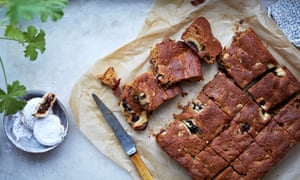
Figgy mulled wine honey cake (main picture)
Dried figs are plumped with the remains of yesterday’s red wine and steeped in spices, then drenched in honey. The texture and stickiness of this one makes it my favourite.
Makes 1 cake 400g dried figs 165g unsalted butter 75g brandy 300mlred wine Zest of 1 orange, and 25mlfreshly squeezed orange juice 250g honey, plus extra for drizzling 1 egg 1½ tsp ground cinnamon ¼ tsp ground cloves 200g wholemeal wheat or wholemeal spelt flour 1½ tsp baking powder ½ tsp bicarbonate of soda
1 Preheat the oven to 180C/350F/gas mark 4 and line a 23cm cake tin with baking parchment.
2 Trim the rough stems off the figs, then chop into 1cm pieces. Cut the butter into small pieces and allow it to soften to room temperature.
3 Put the brandy, wine and dried figs in a heavy-based saucepan and simmer over a medium-low heat to plump the figs. After 15 minutes, remove the pan from the heat and cool for 20 minutes.
4 Add the orange zest and juice, then stir in the butter and honey. Leave for 15 minutes, then whisk in the egg.
5 In a separate bowl, whisk together the cinnamon, cloves, flour, baking powder and bicarbonate of soda. Slowly whisk into the wet ingredients. Transfer the mixture to the prepared tin, and bake for 45 minutes.
6 Cool the cake in the tin for 10 minutes, then turn out on to a plate. To serve, drizzle with a little extra honey and serve warm with yoghurt.
Orange almond syrup cake
Claudia Roden’s orange cake is famous for its use of an orange boiled whole. I’ve spiced it up here with cinnamon, added whole, unpeeled almonds that you grind yourself, and drizzled it with a Cointreau-laced syrup.
Claire Ptak’s orange almond syrup cake. Photograph: Kristin Perers for the Guardian
Makes 1 cake For the cake 2 large oranges 250g whole almonds (skins on) 6 eggs 200g caster sugar 1 tsp baking powder
For the custard 2 bay leaves 300mldouble cream 3 egg yolks 2 tbsp caster sugar
For the syrup Juice and zest of 1 orange 100g caster sugar 100mlwater Juice of 1 lemon 4 tbsp Cointreau or other orange liquor
1 Butter and line a 20cm cake tin with baking parchment.
2 Wash the oranges, then simmer them whole (including their peel) in a saucepan of water for two hours. Cool, then cut open and remove any pips.
3 Grind the almonds to a fine powder in a food processor, then set aside.
4 Preheat the oven to 200C/400F/gas mark 6. Cut the oranges into quarters and put in a food processor. Process to a pulp. Add the ground nuts, then the eggs one at a time, then the sugar and baking powder.
5 Scrape the batter into the prepared tin and bake for about an hour. Cool in the tin, and then turn out on to a serving plate.
6 For the custard, put the bay leaves and the cream in a heavy-based saucepan. Steep over a medium heat just until the cream comes to the boil. Watch it closely as it can boil over.
7 In a bowl, whisk together the yolks and sugar. Temper the yolks with a little of the bay cream, then return to the saucepan and whisk over a low heat for five minutes. Allow to cool.
8 For the syrup, put all the ingredients into a small saucepan. Reduce by half. Skewer the cooled cake, then pour half of the syrup over just before serving. Serve the remaining syrup separately for pouring over individual slices of cake with the custard.
Dulce de leche and chocolate pudding
This is made with the moreish caramel that results from reducing cream and sugar or condensed milk into a jam. Chocolate and cinnamon have a long history together in Mexico and here they make this delicious, self-saucing, flan-like dessert more Christmassy. The cake mixture and the flan mixture could both be made in advance and then assembled and baked closer to the serving time. Alternatively, you could bake the dish a few hours before serving and serve at room temperature, but it really should be made on the day.
Claire Ptak’s dulce de leche and chocolate pudding. Photograph: Kristin Perers for the Guardian
Makes 1 cake 200g dulce de leche ¼ tsp Maldon salt
For the cake 150g caster sugar 100g plain flour 40g cocoa powder 1 tsp ground cinnamon ½ tsp bicarbonate of soda ¼ tsp baking powder A pinch of fine sea salt 180g plain yoghurt 4 tbsp mild olive oil 1 egg
For the flan 340g evaporated milk 400g sweetened condensed milk 4 eggs 1 tsp vanilla
1 Preheat the oven to 190C/375F/gas mark 5 and have ready a roasting tray that is large enough to house a round or oval pudding dish, and is at least 4cm deep. Spread the dulce de leche inside the pudding dish, as if you were buttering it. Sprinkle with the Maldon salt.
2 For the cake, whisk together the dry ingredients. In a separate bowl, whisk together the yoghurt, olive oil and egg. Whisk the wet ingredients into the dry ingredients, and pour into the prepared puddingdish.
3 In a separate bowl, whisk together the evaporated milk, condensed milk, eggs and vanilla. Decant into a jug, and slowly and gently pour this over the chocolate cake mixture. You want to try to keep distinct layers at this stage.
4 Set the pudding dish within the larger roasting tray, then carefully fill the tray with water until it is halfway up the sides of the pudding dish. Cover the whole roasting tray with tin foil (shiny side down), and bake for one hour, until the chocolate cake has risen to the top and is set.
5 Remove from the oven and allow the pudding to cool for 10 minutes in the water. Remove from the water and cool for another 10 minutes. Run a small sharp knife around the perimeter of the pudding to separate it from the dish. Invert on to a serving plate and serve.
Claire Ptak is a pastry chef, author and food stylist and owns Violet Bakery in London. She is the author of the Violet Bakery Cookbook (Square Peg); @violetcakeslondon
The weekend cook: Thomasina Miers’ recipes for the Christmas holidays
An inexpensive Persian rice dish for Christmas Eve, and a light salad for the evening after the blowout lunch
The Christmas countdown has started, and to avoid the usual last-minute fluster, I’m trying to plan ahead. Knowing what we’re going to eat next weekend and beyond means I can get some cooking done early. It also limits panic buys: every year, I never think we have enough food in, but there’s always way too much. I’m making this comforting and inexpensive Persian rice for Christmas Eve, most of which can be made ahead; and a light salad for the evening after the big lunch.
Persian rice with grilled squid, orange zest and crisp onions
This is the type of dish you can eat with a spoon while curled up in a heap or when celebrating around a crowded table. Serves four to six.
6 medium-sized squid 100g brown lentils 200g basmati rice, soaked for 1 hour 6 tbsp olive oil 2 small white onions, peeled and finely chopped 80g sultanas, soaked in boiling water for 10 minutes 1 tsp turmeric 1 stick cinnamon 1 pinch saffron threads, soaked in 100ml warm water
For the onions 150ml vegetable oil 2 white onions, peeled and finely sliced
For the dressing 1 orange 1 lemon ½ small bunch parsley, leaves picked and finely chopped 1 small bunch dill, finely chopped 1 tbsp extra-virgin olive oil
Cut down one side of each squid and open it out. Scrape out any gunk, then wash. Score the inside surface in a criss-cross pattern, but don’t cut all the way through, then refrigerate.
Warm the oil for the onions in a deep pan (or wok) on a medium-low heat, and sweat the onions, stirring often, for 30-40 minutes, until golden and crisp. Transfer to a plate lined with kitchen paper.
Put the lentils and rice in separate small pans, cover both with water, season with salt and bring to a boil. Cook the rice for 10 minutes, drain and leave uncovered to steam dry. Let the lentils cook for 10-15 minutes longer, until just cooked, then drain and steam dry in the same way.
Warm half the olive oil in a casserole and sweat the chopped onions on medium heat for 10 minutes, until soft. Add the sultanas, turmeric and cinnamon, cook for five minutes, then stir into the lentils.
For the dressing, grate the orange and lemon zest into a bowl, then add the onion mix and the herbs. Cut off and discard the lemon pith, roughly chop the flesh, stir this into the salad mix, and season to taste. This can all be done ahead of time.
Just before serving, wipe clean the casserole, add the remaining oil and put on a medium heat. Spoon in half the rice in an even layer, then top with half the lentils, and repeat until both are used up. Poke holes all over the top layer of lentils, and pour the saffron water into the indents. Cover the pan with a clean tea towel and a lid, pulling the towel up and over the lid, to keep it away from the heat source, and cook on a medium heat for 25 minutes, until the bottom layer of rice is golden and crisp.
Five minutes before the rice is done, heat a griddle until smoking hot. Rub the squid in a little oil, salt and pepper, then lay it unscored side down on the griddle, pressing it flat with a fish slice. Cook for a minute a side, then cut into big chunks.
Spoon the rice and lentils on to a platter, scraping the bottom to get all those lovely crunchy bits. Scatter over the squid, spoon on the dressing and top with the onions. Serve hot.
Grilled pear and radicchio salad with blue cheese and tarragon dressing
Thomasina Miers’ grilled pear and radicchio salad with blue cheese and tarragon dressing. Photograph: Louise Hagger for the Guardian. Food styling: Emily Kydd. Prop styling: Jennifer Kay
Grilling gives the pears a lovely smokiness, while the dressing adds a sparkling acidity. Serves four to six.
1 small shallot, peeled and finely sliced 2 tbsp sherry vinegar 4 firm pears, cut lengthways into 2cm slices 50g blue cheese (gorgonzola or stilton) Juice of 1 small lemon 2 tsp creme fraiche 2-3 sprigs tarragon, leaves picked and finely chopped 5 tbsp olive oil 300g radicchio, chicory and watercress leaves, washed and dried
For the nuts 75g shelled walnuts, roughly chopped 15g sugar 1 large pinch sweet pimentón 10g butter
Put the shallot and vinegar in a small bowl, stir and leave to macerate while you get on with the everything else.
Heat a griddle until smoking hot (or heat a grill to its highest setting), then grill the pear slices for two to three minutes a side, until lightly charred, but not cooking them so much that the fruit falls apart. Set aside to cool.
Meanwhile, put the nuts, sugar, pimentón and butter in a small saucepan on a medium-high heat and cook, stirring, for five minutes until the butter and sugar have melted and coated the nuts. Tip out on to a plate covered in greaseproof paper, and separate the nuts a little, so they don’t stick together too much as they cool.
For the dressing, mash the cheese and lemon with a fork, until smoothish, stir in the creme fraiche and tarragon, then slowly whisk in the oil until emulsified and thick. Season to taste. Rip the leaves into random shapes and sizes, and arrange on a platter. Sit the pears on top, followed by the shallots. Break up the nuts with your hands, sprinkle all over the top, then spoon on the dressing and serve at once.
And for the rest of the week…
If, like me, you over-order blue cheese at Christmas, don’t worry. Beaten into an equal amount of mascarpone, it makes a glorious filling for mini cheese scones. Or add some to a rarebit mixture made with strong cheddar or Lincolnshire poacher, for the perfect simple and quick supper. Or use it up in a cheese soufflé. Whizz leftover tarragon with parsley to make a fast salsa verde. And sprinkle excess crisp onions on just about anything.
The weekend cook: Thomasina Miers’ recipes for shin of beef, and doughnuts with armagnac
Simple food that’s big on flavour ticks all the boxes for the Christmas holidays
The Christmas holidays are a perfect opportunity to catch up with friends in the best possible way: over a table of good food. Choose dishes that deliver on flavour, look great and are also deceptively simple: today’s stew, for instance, almost cooks itself. The doughnuts, meanwhile, need a little time to prove, but the kneading is easy and the boozy cream a deliciously decadent alternative to jam. So end the year as you mean to go on, and remind yourself of the power of great food and good company.
Slow-cooked shin of beef with pickled walnuts and onion puree
The sweet onion puree is a lovely backdrop to the deep flavours in the stew. Serves six to eight.
1.5kg beef shin (or other stewing beef), cut into 4cm chunks 2 tbsp plain flour, seasoned (optional) Sea salt and freshly ground black pepper 4 tbsp olive oil 2 medium onions, peeled and finely chopped 1 carrot, cut into roughly 1cm dice 2 sticks celery, cut into roughly 1cm dice 350ml stout 350ml beef (or chicken) stock 3 star anise 3 branches rosemary 60ml red-wine vinegar ½ jar pickled walnuts, cut into slices
For the onion puree 150g butter 8 onions, peeled, halved and finely sliced ¼ nutmeg, freshly grated ½ tsp brown sugar 1 small bunch thyme, leaves picked
Heat the oven to 130C/260F/gas mark ½. Toss the beef in the flour, if using; otherwise, season generously.
Heat half the oil in a large casserole on a medium flame, then fry the vegetables until soft, about eight to 10 minutes, seasoning well as they cook, then remove from the pan.
Turn up the heat and, when the pan is smoking hot, add the remaining oil and brown the beef in batches until caramelised all over (if you overcrowd the pan, the meat will sweat rather than fry, so it won’t brown and you’ll miss out on flavour in the finished dish). Once all the meat is browned, return the beef and vegetables to the casserole and add the stout, stock, star anise and rosemary. Bring to simmering point, then cover and cook in the oven for three hours. Add the vinegar and walnuts, season again to taste, and cook for another hour or so, until the beef is tender and falling apart.
Meanwhile, melt the butter in a wide pan, then add the onions, nutmeg, sugar and thyme. Season well, cook on a medium heat for half an hour, stirring from time to time, until softened but not golden, then blitz smooth with a stick blender.
Serve the beef over some of the warm puree, perhaps with braised red cabbage and mash alongside.
Doughnuts with melted chocolate and armagnac and Earl Grey prune cream
Thomasina Miers’ doughnuts with melted chocolate and armagnac and Earl Grey prune cream. Photograph: Louise Hagger for the Guardian. Food styling: Emily Kydd. Prop styling: Jennifer Kay
The cream in these homemade doughnuts is irresistible. Makes 50 mini doughnuts – allow two to three per person, and freeze whatever dough you don’t need.
7g dried fast-action yeast sachet 50g caster sugar, plus extra for dusting 175ml lukewarm milk 500g strong bread flour, plus extra for dusting 1 tsp fine sea salt 100g unsalted butter, cubed 2 large eggs, beaten 2 litres sunflower oil for deep frying, plus extra for greasing
For the cream 75ml armagnac (or brandy) 30g caster sugar 225g pitted prunes Earl Grey tea (3 bags or 1½ tbsp loose-leaf), steeped in 375ml boiling water 200ml double cream 150g 70% dark chocolate
Mix the yeast in a small bowl with a teaspoon of sugar, then pour on the milk and leave to froth for five minutes. Whisk together the flour, salt and remaining sugar, then rub in the butter with your fingertips.
Make a well in the flour mix, and beat in the eggs and the yeast mixture. Turn out the dough on to a lightly floured surface and knead for 10 minutes, until it feels smooth and springy (or give it five minutes in a mixer with a dough hook). Shape into a ball, put in a lightly greased bowl and cover loosely with clingfilm. Leave in a warm place to rise for an hour, until doubled in size.
Meanwhile, heat the armagnac and sugar in a pan, stirring to dissolve the sugar, then turn off the heat, add the prunes and strained tea, and set aside to infuse for 30 minutes. Blitz smooth with a hand blender. Beat the cream to floppy, soft peaks, and gently fold into the prune mix.
Turn out the dough on to a work surface and knead for a minute. At this stage, freeze whatever dough you don’t need straight away and save it for next time. Divide the remaining dough into 30g pieces and shape each one into a ball. Lay these out on greased, lined baking sheets, making sure there is plenty of space between the balls to allow for rising, and leave to prove for 45 minutes.
Melt the chocolate in a bain-marie or microwave; keep warm on a very low flame. Heat the oil in a large pan to 170C. Frying three to five balls at a time, carefully drop them into the hot oil and fry for three minutes a side. Lift out with a slotted spoon and drain on kitchen towel, then repeat with the remaining dough.
Once all the doughnuts are fried, tip them into a bowl and dust with caster sugar. Arrange on a plate, drizzle over the chocolate sauce and serve with a bowl of the cream, for dunking (or use a piping bag to inject each doughnut with cream).
And for the rest of the week…
The beef improves after cooking, so make it ahead of time, if you can. It makes yummy leftovers, too, particularly on soft polenta or pasta ribbons with plenty of grated parmesan. Pickled walnuts are a fine accompaniment to cold cuts, particularly ham, and cheese plates. Excess prune puree is gorgeous spooned over morning yoghurt or stirred into porridge.
Nigel Slater’s chipolata and cranberry batter pudding recipe
A fine festive version of toad in the hole
The recipe
Make a batter by beating together 2 large eggs and 300ml of full fat milk. Beat in a little salt and 125g of plain flour. Don’t worry about any small lumps. Pull the leaves from 5 sprigs of thyme and stir them into the batter then leave it to rest for 20 minutes. Set the oven at 220C/gas mark 8. Evenly brown 350g of cocktail chipolatas in a little oil or bacon fat. When they are done, add 2 tbsp of marmalade and 100g of fresh or frozen cranberries to the pan and toss the sausages in it to coat them evenly. Pour the fat, together with 3 tbsp of groundnut oil or dripping into a 22cm round metal dish or similar baking tin, add the marmalade-coated sausages and place in the oven to get hot. When the oil and sausages are really hot, add the batter and return to the oven immediately. Bake for 12-15 minutes until the batter is golden and puffed around the edges. Serve immediately. Enough for 2.
The trick
Like its sister recipe the Yorkshire pudding, this one needs really hot fat if it is to achieve any sort of lightness. Let the oil and sausages get as hot as you dare, the oil may shimmer, even smoke a little, before you add the batter in one swoosh. If a thin layer of batter firms up immediately on contact with the hot fat, then the pudding should rise well.
The twist
Pieces of pancetta or smoked bacon are good here, as is black pudding, either instead of or in addition to the sausages. If cranberries are unavailable, try small cubes of sharp apple instead.
Email Nigel at nigel.slater@observer.co.uk or follow him on Twitter @NigelSlater
Rachel Roddy’s Tuscan beef stew recipe
This classic, slow-cooked Tuscan beef stew involves just six ingredients, though this one comes with one extra – a great story, which, as we know, makes all food taste better
Somewhere there is a photograph of my mum clinging to a large terracotta pot. When the picture was taken she was in on the joke. A few hours earlier, however, as she tore open the letter from Customs and Excise, noting that she had illegally brought a Tuscan pot into the UK and that it would be confiscated if she didn’t pay duty, she wasn’t laughing. My dad found it hilarious that she failed to notice that the badly typed letter, complete with Tippex and postmark from his office, was all my handiwork. We let her worry her way through her tea and toast before telling her the truth.
We are not talking some fancy or ancient pot. This was just one of the countless handsome but relatively ordinary terracotta containers that are made and sold around a town called Impruneta, about 15 miles outside Florence. We had been on holiday – our only family trip to Italy – and along with wine and dozens of Botticelli postcards, my mum bought this 5ft tall, goodness-knows-how-heavy pot, which we drove back across France to Harpenden, Hertfordshire. Hence the letter, which I found amusing for years.
Practical jokes aside, Impruneta is famous for terracotta. In her fine book about Florentine food, Emiko Davies explains that this was where, in the 1400s, the Renaissance architect Filippo Brunelleschi sought out the burnt-red roof tiles for the duomo. Apparently, while he was overseeing their production and firing, he would eat peposo, a stew of beef, wine and pepper cooked in a terracotta dish in the mouth of one of the huge kilns. It’s a good story that, like so many good stories, true or not so true, weaves a dish into the fabric of a particular place and time. Peposo balances frugality and liberality, bringing ingredients together in a simple and satisfying way. It is just the thing for these wintry days.
You come across lots of versions and interpretations of this dish, some that begin with a soffritto, others that include root vegetables, many that are rusty red with tomato. The classic version, however, is pared down and essential. Just six ingredients – beef, olive oil, wine, garlic, salt, pepper. Add to this, heat and time – at least two hours at the sort of simmer that has you peering under the pan to check the flame hasn’t gone out. Like the beans last week, there is everyday alchemy at work here, the slow cooking allowing the wine to seep into the meat, rendering it tender and really dark, the garlic simmering into sweetness and then dissolving. Then there is the pepper – lots of it – which seasons the meat and deepens the flavour of the sauce, providing throat-warming heat and spice. It isn’t as fiery as you would imagine, despite the possibly alarming-sounding amount. The wine and beef tame it slightly. In fact, I often end up adding more pepper at the end, especially if I am serving the peposo with mashed potato, which is as traditional as serving it with a bag of crisps. In Tuscany it is accompanied by local unsalted bread.
In my experience, peposo is – like so many stews and braises – improved infinitely by resting it for at least a few hours or, better still, overnight. In another, slightly more organised world, this would be something I made on a Thursday, so that on Friday or Saturday all I’d have to do was warm it, make some extremely buttery mash and open another bottle of wine.
Peposo beef and pepper stew
Adapted from Emiko Davies’s recipe in her book Florentine.
Serves 4 3 tbsp extra virgin olive oil 1kg stewing or braising beef – chuck, flank or neck 3 garlic cloves, peeled but whole 1 bottle red wine, ideally chianti Salt 1 tbsp whole black peppercorns, plus a few extra just in case
To serve Bread or buttery mashed potato
1 Warm the olive oil in a heavy-based casserole or stockpot, then brown the meat in batches over a medium heat. Return all the meat to the pan, add the peeled but whole garlic cloves, the red wine and a pinch of salt. Use a pestle and mortar to pound the peppercorns until fine, then add that to the pan.
2 Bring the pan almost to a boil, then cover and reduce to a simmer for 2-2½ hours or until the meat is very tender but still holding its shape. If you like, remove the lid for the last 45 minutes to reduce the sauce. If you want it reduced further, remove the meat and boil the sauce until slightly thickened, then return the meat to the pan.
3 Taste and add more salt and pepper if needed. Ideally allow to rest for a few hours – better still, overnight – then reheat gently.
Rachel Roddy is a food writer based in Rome, the author of Five Quarters: Recipes and Notes from a Kitchen in Rome (Saltyard) and winner of the André Simon food book awardS
Tuscans know that beans benefit from being baked: they come up richer, rounder and creamier. Serve with fat sausages, as part of a minestrone, or as the Tuscans do: warm, with a little of their own broth and some extra virgin olive oil Tuscans know that beans benefit from being baked: they come up richer, rounder and creamier. Serve with fat sausages, as part of a minestrone, or as the Tuscans do: warm, with a little of their own broth and some extra virgin olive oil
Every year, usually in October, we visit Maremma, a glorious cummerbund of a region straddling lower Tuscany and higher Lazio. We stay at the same hotel, an old-fashioned place that sits in folds of green, run impeccably and kindly by a woman called Graziella, who looks like a combination of Isabella Rossellini, Patricia Routledge and Robin Williams as Mrs Doubtfire. We do the same things: lie in sulphurous hot springs, have one monumental argument, walk, play cards. We eat the same things: aquacotta, white beans, peppery beef stew, bread, and drink red wine. Maremmani know how to cook white beans, simmering them until tender, often in terracotta, and occasionally in time-honoured fashion, al fiasco, in a glass flask in the embers of a fire. Fat, tender, creamy and often still warm, the beans are served with a little of their own broth and some extra virgin olive oil – you can’t talk about white beans in Tuscany without talking about extra virgin olive oil. If Rome taught me to love beans, Maremma made me a bean-eater.
There are plenty of strongly held opinions about cooking beans in Maremma … in Tuscany ... in Italy. Just like learning a language, you listen and repeat; then once you are confident, you do it your way. Then you may get stuck in your ways, digging in your kitchen heels. I am not sure why I had never thought to cook beans in the oven before – which is nearest to the embers, I suppose – but I hadn’t. I now know it is a good way, producing plump, deeply flavoured beans. Not that you can’t get beautifully flavoured beans on the stove top, but it must be something about the effect of baking as opposed to boiling heat, the taste of both beans and broth is richer and rounder somehow. Same with sage and garlic. In the oven, the sage loses its aggressive bitterness, taking on a savoury, almost meaty fragrance. Garlic, too, benefits from baking; it brings out its kinder side, the inside of the cloves becoming so sweet and soft they can be squeezed from the skin like cream from a tube. I add salt to the beans, along with the oil and herbs. (Seasoning at the start is different to seasoning at the end – I don’t believe it toughens the beans as some people say – but if you prefer, add salt at the end.)
Remembering to soak the beans – that’s the thing. One way is never to put them away, even if it is in a large, possibly attractive Kilner jar. Leave them in slightly irritating full view. A friend once suggested leaving beans beside the corkscrew, so when you open a bottle at night, you skittle the beans into a bowl and cover them with water for an overnight swell. The next morning, as you make coffee or tea, you cook them.
Apart from the soak, and the initial almost-boil, these beans really are no bother – five things gathered together, then you let the oven work its everyday alchemy. There are some who think low and slow is best. Just over an hour at 170C works for me.
So what to do with your beans? 450g of beans provides enough for two meals for four people. You could eat them as they do in Maremma, with more olive oil, bread and red wine. Alternatively, they are excellent with fat sausages. You decide whether you want them brothy, or slightly creamier – in which case puree a few beans and then mix them back in.
Then there is minestrone. Fry a soffritto of carrot, onion and celery in extra virgin olive oil. Add a diced potato, some pumpkin, a handful of kale, some parmesan rind and cover with enough bean broth and water to make up a litre. Simmer for 40 minutes and add the beans in the last 10 minutes. If you have leftover minestrone, you could ribollire – reboil and serve it over old bread for ribollita.
So there you have it: suggestions for bean eating as we say goodbye – possibly good riddance – to 2016. I am just glad my brother Ben is too busy doing three shows a day as pantomime dame to read the papers at this time of year, otherwise he might be tempted to leave an aerated comment.
A pan of white beans
Enough for two meals for four people 450g dry cannellini beans 3 garlic cloves 6 sage leaves 5 tbsp extra virgin olive oil Salt
1 Soak the beans in plenty of cold water for 10 hours. Drain and rinse the beans then return to a large ovenproof pot or casserole with a lid. Cover with cold water, making sure the water comes a good couple of fingers above the beans.
2 Preheat the oven to 170C/335F/gas mark 3½. On the stove top, over a medium-low heat, bring the beans slowly to just-before-the-boil (they mustn’t boil), skimming away any surface foam, then add the whole, unpeeled cloves of garlic, sage, a good pinch of salt and olive oil. Cover the pan with the lid and transfer to the oven for 1 hour and 15 minutes, or until the beans are tender and surrounded by just a little cloudy broth. Check the seasoning and squeeze the garlic from the skin and stir it into the broth if you wish. Serve alone with more olive oil on top, with sausages, or as part of a soup.
• Rachel Roddy is a food writer based in Rome, the author of Five Quarters: Recipes and Notes from a Kitchen in Rome (Saltyard) and winner of the André Simon food book award
Mark Olive's Christmas recipe: emu eggnog and pan stuffing with native herbs
The Indigenous chef shares his recipes for festive dishes filled with native Australian herbs and spices
Emu eggnog
200g caster sugar 1 large emu egg or 10 chicken eggs 1.5L full cream milk Vanilla essence 375ml thickened cream 250ml brandy Nutmeg
Cream 150g caster sugar and the egg yolk, slowly adding the sugar while whisking. Heat the milk over a water bath, adding creamed egg and sugar slowly as it thickens and coats the back of a spoon. Chill for an hour in the fridge or sit over an ice bath to cool down. Add the vanilla essence. Beat the cream until it peaks, and set aside. Whisk the egg whites slowly, incorporating the remaining sugar until it peaks. Add the brandy. Fold in the egg whites and the whipped cream.
Served chilled or warm in a tall glass with grated nutmeg.
Pan stuffing with native herbs
100g of warrigal greens or silverbeet 1 loaf light rye bread 1g native thyme or thyme 2g native pepper or black pepper 2g salt bush or pink salt 3 sticks celery, diced 2 medium brown onions, diced 6 leaves of fresh sage, chopped 50g butter 10 whole eggs 2g sea parsley or parsley
Blanch off warrigal greens, rinse under cold water and squeeze out excess moisture. Set aside to dry while you prepare the rest of the mixture. De-crust the bread and cut into small diced pieces and place in a bowl. Add the remaining dry ingredients as well as the chopped warrigal greens and mix through the bread. (The greens may also be chopped and sprinkled on top at the end to give the stuffing a vibrant lift in colour.) Fry off the celery and onions and sage in the butter and stir until soft. Stir through bread mixture. Whisk the eggs and then combine through the stuffing mixture until moist. Add milk if it feels too dry – it should just come together and not be slushy.
Turn out into a baking tray and cook in preheated oven at 160C until firm and browned. Check after 20 minutes. Turn out and cut into appropriate slices.
The 12 tips of Christmas dinner
Panicking about the Christmas mega-banquet? Here’s how Guardian readers and Cook contributors cut it down to size
Get something down you first thing. Photograph: AshleighCadet/Getty Images/iStockphoto
1 Start the day with a good bacon sandwich. You’ll be knocking back the champagne, so it’s sensible to get something in your stomach to get you through. Rosie Birkett
2 Make sure your bird will fit in the oven and you have a roasting dish large enough. Seriously, it’s happened to me before – big bird, small oven. One year, our oven broke, too. We ended up carving up the raw turkey and stir-frying it. Rachel Kelly
3 Less is more if you’re hosting Christmas for the first time. You don’t have to do it all, menu-wise or physically. Delegate to survive! Anyone who likes to chat, give them some peeling and they can talk to you at the same time. Give your creative friends the job of dressing the table and the person you like least the washing-up. Only joking. Melissa Hemsley
Rest your turkey for an hour before carving. Photograph: Dan Jones for the Guardian Be realistic about the time it takes to peel veg. Photograph: margouillatphotos/Getty Images/iStockphoto
4 Be prepared. Everyone laughed at it, but for me making a Gantt chart was key to learning how to cook a big Christmas lunch on time. Work backwards from your intended serving time and be realistic about how long peeling veg etc will take. pchan, via GuardianWitness
5 Don’t try to cram everything into the same oven. The turkey should rest for an hour, loosely covered in tin foil and tea towels, giving you an empty oven in which to roast potatoes and other trimmings. jamesE1, via GuardianWitness
6 Don’t truss the bird – keep the legs loose and hanging free. The leg bones conduct the heat through the thighs, which take more cooking than the breast meat. If you truss it, by the time the legs are cooked, the breast meat will be dry. Peter Gordon
7 Make your stuffing in advance and refrigerate it. Sweat onions and celery for 15 minutes, add breadcrumbs that have had an hour to soak up full-fat milk, stick in an egg or two, and use butcher’s sausage meat with an unconscionable amount of salt. Sage should be fresh rather than dried, which is disgusting. PaperAxe, via GuardianWitness
Add redcurrant jelly for great gravy. Photograph: Katherine Anne Rose for the Observer
8 Don’t skimp on the gravy – in my family there is never enough. My brother only makes gravy from the cooking juices, so by the time his children have flooded their plates with this precious liquor, I’m left with a couple of dabs. I always make a simple chicken gravy a few days before, bolstered up with mushrooms, thyme and sherry, and then blended smooth. It’s ready to go as is, and I then add the roasting juices. If you are really pushed for time, there is a brilliant instant madeira gravy mix from Crosse & Blackwell. Speaking of which, don’t be embarrassed about using the supermarket or other sources of readymade food. Rachel Kelly
9 Add some redcurrant jelly to your gravy. I make my own jelly every year, but you can buy it. Thicken the meat juices with cornflour and add a big glug of red wine and some stock – a cube is fine. When the gravy is cooked through, add a couple of tablespoons of jelly, taste and adjust the seasoning. Great gravy every time. LoveintheMist, via GuardianWitness
10 For extra-crispy roasties, add half a teaspoon of baking soda to the water in which you boil them. The higher pH breaks the pectin down more quickly, giving you fluffier edges and more surface area to crisp up. Andrew Surrey, via GuardianWitness
You’ve earned that gin and tonic. Photograph: Alamy
11 Cooks’ muslin will keep your turkey moist. It needs to be big enough to double and go over the turkey – a metre should do it. Melt a pack of butter in a large pan and soak the muslin in it. Season the turkey, putting more butter and seasoning or herbs under the skin. Drape the muslin over the turkey to enclose it completely. astephanides, via GuardianWitness
12 Gin is the solution. Just when things started to get stressful, oven smoking and pans bubbling, my dad would pour me the strongest G&T imaginable. Then I didn’t care if anyone liked their dinner or not. lizmunstone, via GuardianWitness
Family life: My aunt Gloria, Merry Christmas You Suckers, Hilda’s Christmas pudding
Family life: My aunt Gloria, Merry Christmas You Suckers, Hilda’s Christmas pudding
Snapshot: Aunt Gloria, from Suez to Centre Court
I wish I could remember what had made us smile. This photograph, which sums up my relationship with my aunt Gloria, is a window on to family Christmases past – to which she always brought generosity and energy, and a festive jumper.
I do know that it was taken more than a quarter of a century ago, on Christmas Day 1990. My shirt gives it away: silk, designer, my pride and joy, snapped up in Bloomingdale’s when I was breathless with excitement on my first visit to New York earlier in the year.
Gloria loved to travel and always encouraged me, my brother and sister to ask questions, explore new places and seize the chance of different experiences. With her, we went camping in France and the Scottish Highlands, sought out castles, windmills and stately homes, and trekked to the sights of London. It was Gloria who took me to my first Wimbledon, in 1975, where we cheered Virginia Wade into the quarter-finals from standing room on Centre Court, having risen in the small hours to queue.
When we were children, she drove us into the West End to see the Christmas lights on Regent Street – a moment of heart-stopping excitement. I doubt even the congestion charge would have deterred her.
As a young teacher, for a while she lived a charmed life in Egypt, full of sightseeing and dancing (including one memorable evening with President Tito of Yugoslavia, in town with his entourage). The joy of that time, which came to an abrupt end – via an alarming period of house arrest – with the Suez crisis, never left her. Three subsequent decades in the rough and tumble of education in the London borough of Hackney failed to drum it out of her.
When she died in 2008, we discovered a decade of letters between her and my mother, Laura, contrasting her adventures abroad with the concerns of 1950s domestic life back home: a suitcase of social history, which we later turned into a book. The aunt-shaped gap she left in all our Christmases and family events seems to grow, rather than diminish, with the years. As the photograph suggests, Gloria’s glass was always half full – and that, at least, I can remember. Piers Ford
Playlist: A satirical festive earworm from the 60s
Listen to Merry Christmas You Suckers by Paddy Roberts
Merry Christmas You Suckers by Paddy Roberts
“Merry Christmas you suckers / You miserable men / That old festive season is with you again / You’ll be spending your money on cartloads of junk / And from here to New Year you’ll be drunk as a skunk”
When we were growing up, we (me and my three older sisters) were spoilt each Christmas. My mum and dad’s parents were both alive so, on Christmas Day we had dinner with my mum’s parents and that was followed by Christmas tea with our other granny and grandad.
This meant that, as is the tradition in Germany, we had our own Christmas tree on Christmas Eve. This included putting up and decorating the tree (no long lead-in for us) adorned with lighted candles clipped to the branches. It was a real tree, so the fire hazard was equally real but, hey, it was the early 60s and a Christmas tradition.
Another Christmas tradition was playing a 45rpm vinyl record while we decorated the tree. Playing it once was never enough. Merry Christmas, You Suckers by Paddy Roberts was released in 1962 but much of the content (apart from the reference to waiting for the nuclear blast, perhaps) is as relevant today as it was more than five decades ago. It summed up our family attitude to Christmas (or did the record come first?) but, above all, I have fond memories of my dad laughing heartily each time he heard it (then whistling the tune until Boxing Day). I think this is the reason I liked it so much. Chris Lee
We love to eat: Hilda’s Christmas pudding
A picture of Joy Gladstone’s mother, Hilda, her Christmas pudding, craftwork … and lashings of Cumberland rum butter
Ingredients
85g (3oz) cooking fat 3 tbsp self-raising flour 1.5 cups breadcrumbs 85g (3oz) sugar 225g (8oz) mixed fruit 1 tsp mixed spice ½ tsp ground nutmeg 1 apple (finely grated) 1 carrot (finely grated) 1 potato (finely grated) 1 tbsp lemon juice 1 tsp bicarbonate of soda 3 tbsp warmed milk
Rub the cooking fat into the flour until it is like breadcrumbs. Mix in the breadcrumbs, sugar, mixed fruit, mixed spice, ground nutmeg, apple, carrot and potato. Stir in the lemon juice. Dissolve the bicarbonate of soda into the warmed milk and stir this into the main mixture. Stir well and put in a basin, cover with greaseproof paper and steam for two and a half hours.
“This is a wartime recipe, but one my family prefers to the rich traditional kind,” stated my mother, Hilda Gladstone, in her contribution to the Cumbria-Westmorland WI cookbook published in 1978.
My sisters, cousins and nieces make this recipe every Christmas to keep the family tradition alive.
Sadly, Hilda died in her 80th year in 1996. However, many of her descendants, family and friends gathered in Cumbria in September 2016 for a weekend to celebrate what would have been her 100th birthday. In pride of place on the first evening was a Christmas pudding that I made to Hilda’s recipe, accompanied by lashings of Cumberland rum butter (in a Gladstone pottery sugar bowl, of course), cream and custard.
For the Cumberland rum butter, melt 225g (8oz) butter with 340g (12oz) soft brown sugar and add a teaspoon of ground nutmeg. Pour in half a wine glass of rum and mix well until it starts to thicken. Pour into an attractive old china bowl.
On the Sunday afternoon, a garden party saw 45 people tucking into my elder sister’s scones with homemade raspberry and blackcurrant jams, my younger sister’s thumb-hole tarts and Hilda’s “chocolate stuff” (tiffin), my Bakewell tarts and Victoria sponges, my cousin’s “nutty slack” (origin unsure, but contains cornflakes and nuts!) and other such specialities from Hilda’s farm table, WI cookbooks and the Be-Ro home-baking book.
Also on show during the weekend were many of Hilda’s exquisite examples of canvas work and rugs (all her own designs) plus string (baler twine) mats and craftwork. Each of these had been given as heirlooms, but only after they had been exhibited in WI competitions at various local shows. Joy Gladstone
We’d love to hear your stories
We will pay £25 for every Letter to, Playlist, Snapshot or We Love to Eat we publish. Write to Family Life, The Guardian, Kings Place, 90 York Way, London N1 9GU or email family@theguardian.com. Please include your address and phone number.
Yotam Ottolenghi’s recipes for comfort eating over Christmas
From peppers stuffed with chorizo and almonds to burnt sprouts with a cheesy, gingery dressing: oven bakes, roasts and charred dishes for maximum comfort
I usually do three recipes for this column, but I got a bit overexcited in the run-up to Christmas, so this week I’ve squeezed in four, all of them baked, charred or roasted for extra comfort. (And anyway, what kind of food writer would I be if I didn’t provide a recipe for sprouts at this time of year?) So, happy planning, cooking and feasting.
Chorizo-and-almond-stuffed romano peppers
Serve as a standalone meal, perhaps with a crisp green salad, or as an side for roast chicken. The stuffing mix also works in a chicken and even baked on its own. Serves six.
3 tbsp olive oil 1 onion, peeled and roughly chopped 250g cooking chorizo, cut into 1cm dice 1 green pepper, deseeded and chopped into 1cm pieces 1 large garlic clove, peeled and crushed 1 tsp smoked paprika Salt and black pepper 100g slice sourdough (crust left on) 50g lightly toasted flaked almonds 20g parsley leaves, roughly chopped 20g basil leaves, roughly chopped 100g manchego, cut into 1cm pieces 1 egg, lightly whisked 6 romano peppers 150ml chicken stock
Heat the oven to 200C/390F/gas mark 6. Heat two tablespoons of oil in a large saute pan on a medium-high flame, then fry the onion for seven to eight minutes, stirring often, until soft and caramelised. Add the chorizo, green pepper, garlic, paprika, three-quarters of a teaspoon of salt and plenty of pepper, and fry for seven minutes, stirring every once in a while, until the chorizo is cooked, then leave to cool a little.
Put the sourdough in a food processor and blitz for a minute, to turn it into rough crumbs (the largest pieces should be about 1cm). Tip into a large bowl with the chorizo mixture, almonds, herbs, manchego and egg, and mix well.
Use a small knife to cut a long, narrow V down the centre of each pepper, 2cm wide at the stalk and narrowing down towards the tip. Remove the seeds, then push the stuffing into the peppers, forcing it deep inside. Arrange the peppers on a 20cm x 30cm high-sided baking tray, drizzle with the remaining oil, and season with an eighth of a teaspoon of salt and plenty of pepper. Pour the stock over and around the peppers, then roast for 20 minutes, until the filling has browned. Baste the peppers, cover with foil and cook for a final 15 minutes, until the peppers are soft. Serve hot.
Potato and mushroom pots
This is so rich and comforting that it can act as a meal in itself, maybe with some wilted spinach; thanks to the egg whites, though, the mash is also light and fluffy enough to serve alongside a steak, say. If you don’t have ramekins, cook it in one 20cm x 25cm baking dish. Serves eight as a side dish, or four as a main course.
1.2 kg desiree potatoes 130ml double cream 100g unsalted butter, 30g melted, for brushing Salt 2 tbsp olive oil 300g button mushrooms, chopped 2 tbsp thyme leaves 3 garlic cloves, crushed 10g dried porcini, soaked in 300ml boiling water for 30 minutes 2 eggs, yolks and whites separated 120g mature cheddar, coarsely grated
Heat the oven to 220C/425F/gas mark 7. Put the potatoes on a baking tray and roast for an hour or so, until cooked through. Leave to cool a little, then cut in half and scoop out the flesh with a spoon (you’ll get about 650g). Put the flesh in a bowl with the cream, 70g butter and a teaspoon of salt, mash and set aside.
Turn down the oven to 200C/390F/gas mark 6. Heat the oil in a large saute pan on a high flame, then fry the mushrooms, thyme and garlic for 10 minutes, stirring a few times, until browned. Strain the porcini through a J-cloth directly into the pan, to remove any grit, then stir in rehydrated mushrooms and a third of a teaspoon of salt, and cook for three to four minutes more, until only about 60ml of liquid is left in the pan. Spoon the mix into a food processor and blitz to a coarse paste.
Stir the egg yolks into the potato mix until combined. In a separate large, clean bowl, whisk the egg whites to stiff peaks, then gently fold into the potato.
Brush the insides of eight ramekins (9-10cm wide x 5cm deep) with half the melted butter. Divide half the mashed potato between the ramekins, pressing it down slightly, then top with all the mushroom paste. Spoon the remaining mash on top, so it covers the mushrooms, and flatten a little. Brush with the remaining melted butter, sprinkle with the cheddar and bake for 25-30 minutes, until the potato has risen slightly and is golden brown on top. Rest for a minute or two, then serve.
Burnt brussels sprouts with cream cheese and ginger dressing
Sprouts, like all cabbages, take very well to a little charring. Serves four to six.
50g fresh ginger 280g cream cheese 1 small garlic clove, crushed Finely grated zest of 1 lime, plus 2 tsp lime juice 1 tbsp rice-wine vinegar 2½ tbsp groundnut oil Salt and black pepper 750g brussels sprouts, cut in half lengthways ½ tsp pink peppercorns, crushed with your fingers ½ tsp toasted sesame seeds
Start with the dressing. Peel and grate the ginger on a coarse grater, then push it through a fine-mesh sieve into a medium bowl – you should end up with tablespoon and a half of ginger juice. Add the cream cheese, garlic, lime juice, vinegar, two tablespoons of groundnut oil, three tablespoons of water and a pinch of salt, then whisk until thick.
Put a large nonstick frying pan for which you have a lid on a high heat. Once it’s very hot, add the sprouts cut side down: you don’t want them to overlap, so you may need to cook them in batches. Cover and cook for four minutes, until blackened, then tip into a bowl.
Once all the sprouts are charred, mix them with the remaining half-tablespoon of oil, an eighth of a teaspoon of salt and a good grind of pepper. Spread some of the dressing on a platter and arrange the sprouts burnt side up on top. Dot the rest of the dressing over the sprouts, sprinkle with lime zest, pink peppercorns and sesame seeds, and serve.
Sticky roast guinea fowl with kabocha squash
Yotam Ottolenghi’s sticky roast guinea fowl with kabocha squash. Photograph: Louise Hagger for the Guardian. Food styling: Emily Kydd. Prop styling: Jennifer Kay
Kabocha squash has a creamy, nutty texture that pairs perfectly with the sweet, sticky roasting juices here, but butternut will also work well. And you could use a chicken instead of guinea fowl, if need be: just adjust the cooking times to reflect the larger bird. Check if it’s cooked by piercing the thickest part of the leg with a skewer: if the juices run clear, you’re good to go. The longer you marinate the guinea fowl, the better: 24 hours, if you can, though overnight will do. Serves four.
5 sprigs fresh thyme 10 sage leaves, roughly shredded Finely shaved skin of 1 orange 6 cloves garlic, peeled and crushed with the flat of a knife 2 tsp chilli flakes 12 soft ready-to-eat prunes 2 red onions, peeled and quartered 2 tbsp muscovado sugar 90ml pomegranate molasses 50ml dark soy sauce 150ml olive oil Salt 1 guinea fowl (about 950g), quartered ½ kabocha squash (about 700g), unpeeled and cut into 2cm-thick wedges
Put the first 10 ingredients in a large bowl with six tablespoons of olive oil and half a teaspoon of salt. Add the guinea fowl, toss to coat (as ever, your hands are the best tool for this), then cover with clingfilm and refrigerate for up to 24 hours.
To cook, heat the oven to 190C/375F/gas mark 5. Add the squash to the guinea fowl bowl with the rest of the oil and half a teaspoon of salt. Toss to combine, then tip into a large (roughly 28cm x 34cm) high-sided roasting tray, making sure the bird is skin side up. Cover tightly with foil, roast for 10 minutes, then remove the foil, increase the temperature to 220C/425F/gas mark 7 and cook for 25-30 minutes more, basting a couple of times: you want everything covered in the sticky glaze. If the fowl is done before the squash is ready, lift it out and keep it warm while you give the squash a few minutes more. Leave to rest for a few minutes before serving.
• Yotam Ottolenghi is chef/patron of Ottolenghi and Nopi in London.
Claire Ptak’s baking recipes for Christmas leftovers
The dishes are washed, the games packed away and all that remains is some broken mince pies and a wedge of stilton. The time has come for some bakes – one sweet, the other savoury – that make heroes of your Christmas leftovers
If you are anything like me, you live in horror of running out of food – especially over the festive period. When I have invited guests over, I buy and bake more than I will ever need, then relish getting creative with leftovers in the days that follow. If, once the halls have been undecked and all the dishes washed, you find yourself with a few beaten-up mince pies and a lump of blue cheese, these are the recipes for you.
Blondies are among my favourite things to make because they are a blank canvas for whatever bits and bobs you have in your sweet cupboard, much like chocolate chip cookies. My latest iteration contains broken bits of mince pies and sultanas plumped in brandy. The booze cuts through the sweetness; you could even replace the butter in the recipe with leftover brandy butter. Remember not to overbake the blondies so they stay gooey and chewy, one of the last indulgences of the season.
This year, any blue cheese remnants will find a home in buns, or be rolled into spicy folds of pastry and baked into cheesy scrolls. As with all my baking, I recommend tasting as you go. You could try the recipe with any cheese you have left lying around: cheddar, lancashire, parmesan … And be bold with your spicing: if you fancy a little more bite, just add a pinch of cayenne pepper.
Leftover mince pies and sultanas soaked in brandy are key ingredients in these blondies. Photograph: Kristin Perers for the Guardian
Mince pie blondies
Serves 12 50ml brandy, cognac or rum 170g sultanas Juice and zest of an orange 250g unsalted butter 2 eggs 200g light brown sugar 1 ½ tsp vanilla 250g flour 1½ tsp baking powder 1½ tsp fine salt About 210g leftover mince pies
1 Heat the oven to 160C/325F/gas mark 3. Butter a 30x20cm baking tin and line with greaseproof paper.
2 Put the brandy, sultanas, orange juice and zest in a small saucepan over a low heat until the fruit has plumped up. Remove from the heat, cover and set aside.
3 Melt the butter in a small, heavy-bottomed saucepan and set aside to cool slightly.
4 In a large bowl, whisk together the eggs and sugar until fluffy. Whisk in the vanilla.
5 In a separate bowl, whisk together the flour, baking powder and salt. Add this to the egg mixture, and mix until just combined. Stir in the sultanas.
6 Pour the mixture into the prepared baking tin and smooth the top with a palette knife or spatula. Break up the mince pies with your fingers, then sprinkle the chunks over the top. Bake the blondies for 30 minutes. The centre should be puffed and set but still a little gooey.
7 Leave to cool completely in the tin, then cut into 12 thick but smallish pieces. These will keep well for up to 3 days in an airtight container.
Blue cheese buns
Makes 12 560g plain flour, plus more to roll 2 tsp baking powder 2 tsp fine salt 2 tsp paprika 250g unsalted butter, cold and cut into cubes, plus 50g for melting and extra for greasing 300ml cold milk About 350g blue cheese 1 egg plus 1 tbsp milk, for brushing
1 Heat the oven to 200C/400F/gas mark 6. Butter a 12-cup deep muffin tray.
2 To make the dough, combine the flour, baking powder, salt and paprika with the diced butter in the bowl of a food mixer until you have a coarse meal. Slowly pour in the cold milk while the mixer is running, until the dough forms into a ball and comes away from the edges of the bowl. Turn the dough out on to a lightly floured surface and leave to rest for a few minutes. Fold the dough gently over itself once or twice to pull it all together. Let the dough rest a second time, for 10 minutes.
3 Melt 50g butter in a small saucepan, then set aside to cool slightly.
4 Clear a large work surface, dust lightly with more flour and roll out the dough into a large rectangle about 5mm thick. Brush the surface of the dough with the melted butter and, before the butter hardens, crumble over the blue cheese.
5 Now roll up the dough, starting at the long side, keeping it neat and tight. Gently tug the dough towards you to keep it taut while rolling away from you. Once it’s all rolled up, gently squeeze it to ensure it’s the same thickness throughout. Using a sharp knife, cut the roll crossways into 12 even slices. Take a slice of the blue cheese roll, peel back about 5cm of the loose end of the pastry and tuck this flap under the roll to loosely cover the bottom. Place each slice in the muffin tray, flap-side down. Repeat with the remaining slices.
6 Beat the egg lightly with the milk, then brush this over the surface of the buns.
7 Bake for 25 minutes. As soon as the buns are out of the oven, flip them out on to a wire cooling rack, so that they don’t stick to the tray.
• Claire Ptak is a pastry chef, author and food stylist and owns Violet Bakery in London. She is the author of the Violet Bakery Cookbook (Square Peg); @violetcakeslondon
Yotam Ottolenghi’s noodle recipes for post-Christmas comfort
Forget turkey sandwiches. The food I’ll be craving after the Christmas feast will feature noodles in a big way
Even people who love new recipe ideas hit saturation point at some time in the year. And that’s usually about now. We spend the weeks leading up to Christmas entertaining all the different possibilities being shared left, right and centre, and then, right at the last minute, remember that the traditional festive meal is nothing more than a big roast dinner with all sorts of tasty trimmings. That’s when we realise that Christmas will still happen even if we don’t transform into an entirely different cook from the one we are the rest of the year.
When you put on your apron to get ready for tomorrow’s main event, don’t forget that everyone prefers a regular meal and a chilled-out host to some elaborate feast and a stressed-out cook. If you cook what you love to eat and eat what you love to cook, your day will be a happy one. It’s this way of thinking that informs so much of what I cook, eat and share with family and friends all year round. It’s also why I’m as likely to be slurping on a bowl of noodles on Boxing Day as tucking into yet another turkey sandwich or chunk of stilton. Today’s recipes are all about the ingredients I’ll be craving over the next week.
Green tea noodles with lime and cardamom salsa, avocado and egg
I’ll happily eat this at any time of day, and especially for a late weekend breakfast. You can get green tea soba noodles from large supermarkets and Asian food stores; regular soba noodles, which are even more widely available, are a good alternative.
For the perfect boiled egg, with a firm white and runny yolk, bring a medium pot of water to a boil on a high heat. Carefully lower in four room-temperature eggs (if your eggs are fridge-cold, they’ll take longer to cook) and leave to bubble away for six minutes. Lift out the eggs and transfer to a bowl in the sink and leave under cold running water for a minute or two, to halt the cooking process. Just before serving, peel off the shell and cut or tear the egg in half. Serves four.
200g green tea soba noodles (or regular soba) 30g basil leaves, picked and roughly chopped 30g coriander leaves, picked and roughly chopped 70g pistachio kernels, lightly toasted and roughly chopped ½ tsp ground cardamom 3 limes – finely grate one (to get ½ tsp zest), squeeze another (to get 3 tbsp juice) and cut the third into quarters 3 tbsp groundnut oil 1 small garlic clove, peeled and crushed 1 green chilli, deseeded and finely chopped Salt 2 ripe avocados, cut into 0.5cm slices 4 eggs, soft-boiled (see introduction) ¼ tsp nigella seeds
Cook the noodles according to the instructions on the packet (cooking times vary from brand to brand), then refresh under cold water and transfer to a colander to drain.
Put the basil, coriander, pistachios, cardamom, lime zest, lime juice, oil, garlic, chilli and half a teaspoon of salt in a large bowl. Mix to combine, then add the noodles and divide between four bowls. Arrange the avocado slices on top of each serving, and top with two egg halves (peel and cut them just before serving). Finish with a sprinkle of nigella seeds, and serve each portion with a wedge of lime.
Rice noodle salad with cucumber and poppy seeds
It’s easy to get stuck in our ways with apples. A granny smith is sweet and tart enough to work here, but why not try something new for a change? My local grocer, Parkway Greens in Camden, gets some of its apples from Brogdale in Kent, home of the National Fruit Collection, and I recently munched my way through eight varieties I’d never tried before. They were as delicious and different from each other as bottles in a mixed case of wine. Serves six to eight.
60ml cider vinegar 30g caster sugar 1 small red onion, peeled and finely sliced 5cm piece ginger, peeled and julienned 150g flat rice noodles, broken into roughly 15cm pieces 3 tbsp olive oil 200g frozen edamame, quickly blanched, drained and dried 1 sweet, sharp apple, cored and cut into 2mm-thick wedges 2 large 400g cucumbers, cut in half lengthways, seeds scooped out and flesh cut into long, thin strips 2 red chillies, deseeded and julienned 10g mint leaves, roughly shredded 10g tarragon leaves, roughly chopped 1 tbsp poppy seeds Salt and black pepper
Put the vinegar, sugar and 60ml water in a small saucepan on a high heat. Bring to a boil, stir until the sugar has dissolved, then cook for two minutes, until the liquid has reduced by a third. Put the onion and ginger in a small bowl, pour over the hot liquid and set aside for an hour, until the vegetables have softened.
Put the noodles in a large bowl and pour over enough boiling water to cover. Set aside for 10-15 minutes, until the noodles are soft, then drain and put in a large bowl. Toss with a tablespoon of oil and leave to cool.
Add all the other ingredients to the noodles, including the pickled onion and ginger, and their pickling juices, and season with a teaspoon and a half of salt and plenty of black pepper. Toss and serve at once.
Black rice noodles and mango salad with soy roast salmon
Yotam Ottolenghi’s black rice noodles and mango salad with soy roast salmon. Photograph: Louise Hagger for the Guardian. Food styling: Emily Kydd. Prop styling: Jennifer Kay
Lots of alternatives here, if you want: use regular basil if you can’t find Thai basil (although a lot of supermarkets do sell it) and if you can’t get hold of a green mango, use a regular mango instead. You don’t want it too ripe and sweet, though – green mangoes have a welcome tartness – and you might want to reduce the sugar in the dressing down to 20 grams. The black noodles look great against the salmon but, again, these can be replaced with whatever you can find: udon and soba both work well as substitutes. If you have a mandolin, then now is the time to use it for the vegetables. If you don’t, keep a lookout in the post-Christmas sales. Serves four.
For the salad 85g black rice noodles (or soba, udon, etc, if you can’t find black ones) 2 large carrots, peeled and julienned 4cm piece ginger, peeled and julienned 150g beansprouts 2 small shallots, peeled and finely sliced 1 green mango (or a not-too-ripe regular mango), peeled, stoned, and flesh cut into julienne strips 10g Thai basil leaves 10g mint leaves 10g coriander leaves 2 tbsp toasted sesame seeds (white and black, ideally), plus 2 tsp extra, to serve
For the dressing 2 tbsp groundnut oil 3 tbsp lime juice, plus 1 lime, quartered, to serve 1 tbsp mirin Salt
Put the vinegar and sugar in a small saucepan on a high heat. Stir until the sugar dissolves, then leave to boil for two minutes, until you’re left with a thick syrup. Take off the heat and stir in the chilli, half a teaspoon of sesame oil, and the soy and fish sauces. Put the salmon fillets in a bowl and pour this mixture all over them, then add an eighth of a teaspoon of salt, turn to coat the fish and leave to marinate for 10 minutes.
Mix all the dressing ingredients with the remaining half-teaspoon of sesame oil and a teaspoon of salt, and put to one side.
Heat the oven to 220C/425F/gas mark 7. Half-fill a medium saucepan with water, bring to a boil, then cook the noodles for four to five minutes (or according to the instructions). Drain, refresh under cold water to stop the noodles cooking more, drain again and put in a large bowl with the other salad ingredients.
Put the salmon fillets skin side down in a small baking dish (about 20cm x 30cm), so they fit snugly, pour over the marinade and roast for 12 minutes, basting the fish twice, until caramelised and cooked, but still a little pink in the middle. Remove and keep warm.
Just before serving, pour the dressing over the salad and toss. Divide between four shallow bowls and top each serving with a warm salmon fillet, skin side down, and a drizzle of the cooking juices. Sprinkle with the remaining sesame seeds and serve with a lime wedge.
• Yotam Ottolenghi is chef/patron of Ottolenghi and Nopi in London.