Our social:

Latest Post

Monday, September 5, 2016

Two refreshing late-summer soup recipes

Lightness and brightness are the watchwords for summer soups. Try a coconut, lemongrass and lime broth, or courgette and baby gem bowlful to lighten up your day

Most years, soups – like pies, stews and crumbles – are banished for the summer before I cook them in an excited flurry about the same time as I stop wearing sandals.

In winter, I find comfort in deep bowls of vegetables that don’t require chewing. But summer soups are different. I want freshness, crunch, and zippy flavours. So many summer soups are cold, and while I do like a cold soup, I have to say I only crave it when the weather is blistering. I almost always want something warm at dinner time.

These late summer soups focus on lightness and brightness. Some days it’s a summery dal of red lentils, spiked with a heap of turmeric and finished with a brave amount of lemon juice. Other days it’s a quick tomato soup, cooked with garlic, no onion, the vines kept on until it’s blended and then finished with a lot of good olive oil.

When I do crave a cold soup, I pile the blender with a couple of scooped‑out avocados, a head of fennel, a couple of spring onions, the juice of a lemon and some summer herbs, blended with a good handful of ice and drizzled again with good oil when it’s served.

There are, of course, gazpacho soups too, my favourite being a white one that’s made with almonds, grapes and bread soaked in vinegar.

This week though, it was a warm coconut soup with one of the freshest, cleanest flavour pairings I know: lemongrass and lime leaves. The next one has been made from the hero of the hour: papery husked corn on the cob (not least because its currently my little boy’s favourite vegetable) teamed up with green chilli, courgettes and crisp lettuce. The result: a soup layered with texture and freshness that cooks in an instant.
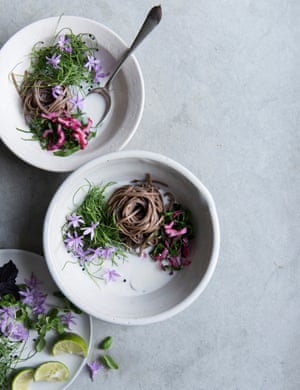
Coconut broth with buckwheat noodles, tofu and lime
Coconut broth with buckwheat noodles, tofu and lime: ‘Lemongrass and lime leaves is one of the freshest, cleanest flavour pairings I know.’ Photograph: Issy Croker for the Guardian

Coconut broth with buckwheat noodles, tofu and lime

There are some evenings when I feel like I’ve absorbed the day. The clean white of this broth whispers that all away. The coconut milk calms and soothes, the chilli boosts and wakens, and the lemongrass and lime leaves bring an unrivalled citrus freshness.

I pick up bundles of lemongrass and lime leaves whenever I see them and pop them into the freezer – they keep well and can be used from frozen. I use 100% buckwheat flour noodles – some are mixed with normal flour, which are easier to cook; if you use the 100% ones, make sure you don’t overcook them and refresh them in lots of cold water immediately.

Serves 4
2 × 400g tins coconut milk
1 vegetable stock cube or 1 tbsp powder
2 lemongrass stalks
4 lime leaves (optional)
1 shallot, peeled and finely sliced
2 garlic cloves, peeled and halved
1 red chilli, roughly chopped
2 tbsp coconut sugar or caster sugar
A bunch of fresh coriander
200g buckwheat noodles
250g chard or other summery greens, washed and shredded
2 tbsp soy sauce or tamari
Juice of 2 limes

To serve
A bunch of chives or garlic chives, and their flowers
A handful of one or all of the following: basil, purple basil, coriander, mint

1 Pour the coconut milk into a large pan and add a canful of water and the stock cube or powder. Bash the lemongrass with a rolling pin until it’s smashed, to help release the flavours more quickly. Add to the pan with the lime leaves (if you are using them), shallot, garlic, chilli and sugar. Cut the roots off the coriander and add that too.

2 Push all the aromatics into the liquid so they are covered and turn the heat on under the pan. Bring to a gentle simmer, then allow to bubble for 15 minutes, or until you have an intensely flavoured coconut broth.

3 Meanwhile, cook the noodles in a pan of boiling water – they will take 8-10 minutes, but all brands are different so check the instructions on yours. Once cooked, drain and refresh in cold water, then put to one side. While they are cooking, wash and shred the chard. Shred the stalks as finely as you can but chop the leaves a little bigger.

4 Next, take the broth pan off the heat and sieve the broth into a bowl, discarding all the aromatics (they have done their work now) and add the soy sauce and lime juice.

5 Divide the noodles into each bowl. Next to the noodles, pile up a quarter of the shredded chard and finally pour the warm soup over the lot. Top with the chives and herbs and, if you like, a little more lime.
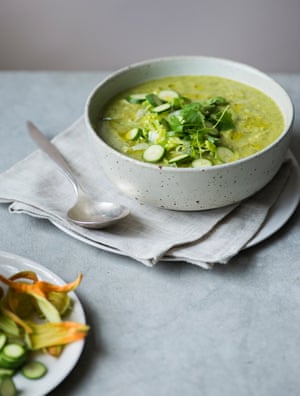
Corn, courgette and baby gem soup
Corn, courgette and baby gem soup. Photograph: Issy Croker for the Guardian

Corn, courgette and baby gem soup

This is loosely based on a corn soup recipe by Diana Kennedy, a fastidious researcher and writer on Mexican food. Courgettes come in all sizes, so use two medium ones as a guide. If it is searingly hot outside, this soup is excellent cold too.

Serves 4
2 medium courgettes
4 tbsp butter or olive oil
1 onion, peeled and finely chopped
2 garlic cloves, finely chopped
4 ears of corn, kernels only
Up to 1 litre of water
A small handful of fresh coriander, plus more to serve
1 green chilli
2 little gems, washed and shredded
Sea salt

1 Grate 1½ courgettes (you will use the other half later) on a standard box grater. Heat 1 tbsp of the butter or oil in a large, deep pan, add the grated courgettes and cook for a few minutes, until they are soft and beginning to colour. Then tip the lot into a blender (you can use a hand blender too) and blitz a little, keeping a bit of texture. Put to one side.

2 Heat a little more oil or butter and fry the onion and garlic, without browning, until soft. Add the courgette mixture and cook for another couple of minutes.

3 Blitz the corn kernels in the blender with up to 1 litre water (depending on what consistency you like), most of the coriander leaves (saving a few to finish) and all the stalks, the chilli and most of the shredded lettuce. Blitz until smooth.

4 Add the corn mixture to the pan with the courgettes and onions, then cook on a medium heat for another few minutes, stirring and scraping the bottom of the pan to stop the mixture from sticking. Season to taste.

5 Meanwhile, cut the remaining half courgette into thick coins. Once the soup is warmed through, ladle into bowls and finish with the remaining lettuce, coriander and the little courgette coins.

  • Anna Jones is a chef, writer and author of A Modern Way to Eat and A Modern Way to Cook (Fourth Estate); annajones.co.uk; @we_are_food


Sunday, September 4, 2016

Nigel Slater’s frosted plum cake for autumn

Now’s the time for warming soft fruits – and maybe some roast onions too

Now, for the crimson and golden plums – the ‘Czar’ and ‘Marjorie’s Seedling’, the ‘Opal’ and then ‘Victoria’ (she’s at her best when fully ripened, so beads of nectar gather at the tip).

Even for breakfast, cooked till they have softened enough to crush effortlessly between finger and thumb, their syrup shot with glowing ruby, plums appreciate a dusting of spice: ground ginger perhaps, cinnamon definitely. I give them cardamom, too – the black seeds tweaked out of their green pods and ground to a grey dust.

Plums will cook to a golden jelly in a cake, but are best in one made with the darker sugars, such as light or dark muscovado, and to which you have added ground ginger or mixed spice. The sugar’s butterscotch notes serve the fruit well.

With a plum cake baking, there was an excuse to roast onions while the oven was warm. A bit early perhaps, but I am eager to get to autumn food. I cooked them with butter, thyme and olive oil, leaving them soft and gold, their flesh translucent. (Left for long enough they will caramelise a little, too.) The smell of them roasting put me into autumn gear, piling them on top of a silky pool of polenta into whose golden depths I let cheese soften and melt.

Soft cheese polenta with roast onions

A soft, almost soupy polenta to eat with roasted onions. I sometimes add 100ml of double cream, warmed in a small saucepan, to the polenta. I use Tunworth or other soft cheese to finish. Camembert will do.

Serves 4
For the onions:
onions 4, medium-sized
olive oil 50g
butter 60g
thyme sprigs 10

For the polenta:
water 500ml
full-cream milk 500ml
fine polenta 150g
butter 50g
parmesan 100g, finely grated
soft cheese to finish 200g

Directions

Set the oven at 200C/gas mark 6. Peel the onions, halve them then cut each half in two. Put them in a roasting tin, trickle the oil over them, dot with butter and a few sprigs of thyme then bake for 20-30 minutes till golden and soft, basting from time to time.

Make the polenta. Pour the water and milk into a large, deep pan and place over a moderate heat. Bring the mixture to the boil, then salt generously. Rain the polenta into the liquid in a steady stream, stirring continuously. Take great care that the mixture doesn’t bubble and spit at you (it can be like a volcano). Lower the heat as necessary.

Keep stirring over the heat for a good 20 minutes until the mixture is smooth, creamy but not too thick. Beat the butter into the polenta.

Stir the grated parmesan into the polenta. (At this point you could add a little warmed cream.) Add salt and black pepper to taste. Spoon the polenta into warm dishes and top with the baked onions. Place the cheese on top of the onions and let it soften.

Spicing and icing: wholemeal plum cake.
Spicing and icing: wholemeal plum cake. Photograph: Jonathan Lovekin for the Observer

Wholemeal plum cake, spiced frosting

Serves 8
For the cake:
butter 200g
light muscovado sugar 75g
golden caster 75g
hazelnuts 100g, skinned
plums 500g, medium-sized
eggs 4
self-raising wholemeal flour 150g
baking powder 1 tsp
ground cinnamon ½ tsp
salt a pinch

For the icing:
icing sugar 150g
lemon juice 3 tsp
ground cinnamon a pinch
cardamom pods 6
sesame seeds 2 tsp
poppy seeds 2 tsp
dried rose petals 2 tsp

Directions

Set the oven at 160C/gas mark 3. Line the base of a 22cm spring-form baking tin. Dice the butter and put it in a food mixer with the sugars and beat for 5 minutes, till light and fluffy – the colour of latte. Regularly push the mixture down from the sides of the bowl with a rubber spatula to ensure even creaming.

While the butter and sugar cream, toast the hazelnuts in a dry pan, watching carefully and moving them round the pan so they colour evenly. Grind to a fine powder in a food processor. Cut the plums in half and discard their stones.

Beat the eggs lightly with a fork then add, slowly, with the paddle turning, to the butter and sugar. Combine the flour and baking powder, cinnamon and salt, then add to the batter, mixing it together thoroughly. Scrape the batter into the lined cake tin and gently smooth the surface.

Place the plums evenly on the surface of the cake. You want them to sink into the body of the cake as it bakes. Bake for 50–60 minutes till the cake is spongy to the touch. (Test for doneness after 50 minutes with a metal skewer: it should come out without any uncooked cake mixture sticking to it.)

Remove the cake from the oven and leave to settle for 20 minutes. Run a palette knife around the inside of the tin to the loosen the cake, then undo the tin and place on a plate.

Make the icing: sieve the icing sugar into a bowl, stir in the lemon juice, adding a little water if required to bring it to a thick, pouring consistency. Stir in the ground cinnamon. Crack open the cardamom pods, remove the seeds and grind them to a fine powder. Stir into the icing. Lightly toast the sesame seeds in a dry pan till golden, then mix them with the poppy seeds and rose petals.

Transfer the cake to a plate, then trickle the spiced icing over the surface. Scatter with the poppy seeds and rose petals.

Email Nigel at nigel.slater@observer.co.uk or follow him on Twitter @NigelSlater

Saturday, September 3, 2016

Cocktail of the week: make hay with a Pitchfork

The Sun Tavern’s drinks maestro combines cider, gin and hay (yes, really) to create a late summer tipple to satisfy farmer and town-dweller alike

A refreshing long drink for the end of summer; it’s dead easy to make, too. For the hay cordial, just steep clean fresh hay (from a just-cut field or the pet shop) in a 50:50 sugar syrup; failing that, use green tea. Serves one.

50ml gin (we use Plymouth Navy Strength)
100ml hay cordial (or green tea)
25ml fresh lemon juice
Medium sweet cider, to top
1 slice each dried orange and green apple, to garnish

Pour the gin, cordial and lemon juice over ice into a tall glass or tankard. Top with cider, garnish with the dried fruit, and serve.

• The Sun Tavern, London E2.

Purple patch: Yotam Ottolenghi’s aubergine recipes

Yotam Ottolenghi celebrates his 500th column by revisiting a favourite ingredient

Today marks my 500th column and I’m feeling rather sentimental. When I began writing for the Guardian in 2006, my main worry was running out of ideas. Now, after about 1,000 recipes, I can probably lay that particular concern to rest: I love writing recipes in general, and recipes for aubergine in particular, so forgive me for coming back to them for a second week in a row. Somehow, the inspiration just keeps on coming, as this week’s crop illustrates, be it from my home town, Jerusalem, from my new home in Britain or from farther afield in south-east Asia, where I now often look for fresh, delicious ideas.

Glazed baby aubergines stuffed with pork and tofu

Serve as a canapé or snack, or as a main course with some sticky rice. Serves six as a main, more as a snack.

1kg baby aubergines (anywhere between 20 and 50, depending on size), slashed 1-3cm deep from stalk to base
3 tbsp groundnut oil
Salt
15g dried shrimp
300g minced pork
150g silken tofu
1 shallot, peeled and finely chopped
2cm piece ginger, peeled and finely chopped
10g coriander, roughly chopped
1 green chilli, deseeded and finely chopped
1 garlic cloves, peeled and crushed
½ tsp fish sauce
3 tbsp light soy sauce
90ml mirin
2½ tbsp rice vinegar
1¼ tsp white miso
1¼ tsp sesame oil
2 spring onions, finely sliced on an angle
1 tbsp toasted sesame seeds

Heat the oven to 220C/425F/gas mark 7. Toss the aubergines in a large bowl with the oil and a quarter-teaspoon of salt, then lay cut side up on a large oven tray lined with baking paper. Drizzle over the oil from the bowl, roast for 15-25 minutes (depending on size) and leave to cool.

Put a small frying pan on a medium-high heat, then dry-fry the shrimp for two minutes, until there is a strong smell. Finely chop the shrimp, then mix in a bowl with the pork, tofu, shallot, ginger, coriander, chilli, garlic, fish sauce, a tablespoon and a half of soy and a quarter-teaspoon of salt, and put in the fridge.

Pour the remaining soy sauce into a small saucepan with the mirin, rice vinegar, miso and sesame oil, bring to a boil and cook, whisking all the time, for two to three minutes, until the sauce thickens, then set aside.

Spoon the pork mixture into the slashes in each aubergine, then brush all over with half of the glaze and bake for 15 minutes, until the pork is cooked and the aubergines are totally soft. Brush any cooking liquid from the tray over the top, and drizzle over any leftover glaze. Serve warm, with chopped spring onion and sesame seeds sprinkled on top.

Smoked aubergine and almond scotch eggs

A vegetarian scotch egg? It’s not as daft an idea as it at first seems, actually. If you can’t get small eggs, use medium ones instead, but you’ll have only enough aubergine to cover seven eggs, and they’ll need 30 seconds more cooking. Makes eight (or seven).

3 large aubergines (900g)
50g ground almonds
30g whole almonds, roughly chopped
2 tbsp olive oil
1 onion, peeled and finely chopped
1 garlic clove, peeled and crushed
5g picked thyme leaves
5g oregano leaves, roughly chopped
1 tsp smoked paprika
1½ tsp urfa chilli flakes (or half the amount regular chilli flakes)
½ tsp ground cumin
50g manchego, roughly grated
Salt
8 small (or 7 medium) eggs, plus 2 extra
75g plain flour
100g panko breadcrumbs
1½ tsp nigella seeds
1 litre sunflower oil, for frying

Put a ridged griddle pan on a high heat and ventilate the kitchen. Once the griddle is very hot, lay on the aubergines and grill for 45 minutes, turning occasionally, until charred all over and the flesh within is soft and smoked (or cook them on three open flames on the hob, in which case they’ll take only 15-20 minutes). Put the aubergines in a bowl and, once cool enough to handle, scoop out the flesh and discard the black skin. Put the flesh in a colander and set aside for an hour, squeezing it three or four times, to extract as much liquid as you can: you should be left with about 100g aubergine flesh. Transfer to a large bowl.

Heat the oven to 170C/335F/gas mark 3. Spread out all the almonds on a small oven tray, roast for 10 minutes, until golden-brown, then add to the aubergine bowl.

Heat the olive oil in a medium frying pan on a medium-high flame, then fry the onion for eight minutes, stirring a few times, until caramelised and soft. Add the garlic, herbs and spices, cook for another minute and add to the aubergine mix. Stir in the cheese and a third of a teaspoon salt.

Bring a medium saucepan of water to a boil, then lower in eight (or seven) eggs and boil for five minutes. Plunge them into cold water, to stop the cooking, then peel carefully.

Break the remaining two eggs into a small bowl and whisk. Put the flour in a second small bowl with half a teaspoon of salt, and mix the panko and nigella seeds in a third bowl.

Divide the aubergine mix into eight (or seven) equal portions and place each one between two sheets of clingfilm. Using your hands, press down each aubergine portion into a 10-11cm diameter circle about 0.5cm thick. Peel off the top layer of clingfilm and put a peeled egg in the centre of the aubergine circle. Draw up the sides of the clingfilm under the aubergine, so the mix envelops the egg completely, then set aside and repeat with the remaining eggs. Working with one aubergine-encased egg at a time, roll it first in the flour, then dip in the egg and finally roll in the panko mix, to coat all over. Repeat with the remaining eggs.

Heat the sunflower oil in a medium saucepan on a medium flame. When the oil reaches 175C, deep-fry two eggs at a time for three to four minutes, turning them halfway, until golden-brown all over. Use a slotted spoon to transfer to a plate lined with kitchen paper, and repeat with the remaining eggs.

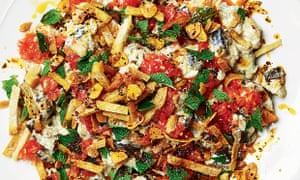
Warm yoghurt and aubergine with fresh tomato shredded pitta crisps

Yotam Ottolenghi’s warm yoghurt and aubergine with fresh tomato shredded pitta crisps.
Yotam Ottolenghi’s warm yoghurt and aubergine with fresh tomato shredded pitta crisps. Photograph: Louise Hagger for the Guardian. Food styling: Emily Kydd. Prop styling: Jennifer Kay

This take on fetteh, a Levantine dish made with stale flatbread and various toppings, makes a hefty weekend breakfast or a light supper. Serves six.

4 aubergines, peeled lengthways in alternate strips, so it ends up covered in purple-and-white stripes, then cut widthways into 1.5-2cm rounds
120ml olive oil
Salt and black pepper
1½ thin pitta breads (about 100g), stale or fresh
2 garlic cloves, peeled and finely sliced
1 tsp Aleppo chilli flakes (or ½ tsp regular chilli flakes)
300g natural yoghurt (around 4% fat)
2 tsp lemon juice
2 tomatoes, roughly grated (discard the skins)
10g mint leaves, roughly torn

Heat the oven to 220C/425F/gas mark 7. Arrange the slices of aubergine on two or three oven trays lined with baking paper, making sure they don’t overlap. Brush both sides of each aubergine slice with olive oil (you’ll need about four tablespoons-worth for this), then sprinkle with half a teaspoon of salt and plenty of pepper. Roast for 30 minutes, until the aubergines are soft and brown, then remove from the oven.

Turn down the oven to 180C/350F/gas mark 4. Split open the pitta, as you would when stuffing it, then pull apart and separate the two halves. Roll each half into a tight roll and cut into long, thin 2-3mm-wide strips. Put these in a medium bowl and mix with two tablespoons of oil, an eighth of a teaspoon of salt and plenty of pepper. Spread out on a small oven tray and bake for 10 minutes, until golden brown and crisp, then set aside.

Heat the remaining two tablespoons of oil in a small saucepan on a medium-high flame. Fry the garlic and chilli flakes for two to three minutes, until the garlic just starts to brown, then tip into a small bowl.

Pour the yoghurt into a large saute pan and put it on a medium heat. Warm through for four to five minutes, until the yoghurt starts to steam – don’t take it any further than this, otherwise it will split. Add the lemon juice, cooked aubergine slices, four tablespoons of water and a quarter-teaspoon salt, and cook, stirring gently every now and then, for five minutes, until the yoghurt just starts to thicken.

Pour the aubergine and warm yoghurt mix into a shallow serving bowl and spoon over the tomato and mint. Top with the pitta, roughly breaking up the pieces as you go, and finish with a drizzle of garlic and chilli oil. Serve at once or at room temperature.

• Yotam Ottolenghi is chef/patron of Ottolenghi and Nopi in London.

Claire Ptak’s wine-roasted fig and fennel ice-cream recipe

A trip through California’s Napa Valley inspires a red wine and fennel combo that takes roasted figs to an indulgent new high. Frozen into ice-cream, they make a figgy freezer favourite that has a satisfying gelato-like texture

My husband and I and our 7 month-old baby arrived in California last week for an extended stay. We are sharing parental leave and it’s his turn to take over. My work happens to bring me back to my home state, so we are making the most of it, starting with a little holiday in the Napa Valley wine region. Driving here from the coast north of San Francisco, I am struck by the dry, golden grass-covered rolling hills. Most of the area we drive through is agricultural. We go by grazing beef cattle and dairy cows and chicken caravans for facilitating free-ranging before we pass olive groves and finally vineyards. All along the way, the wide open roads are lined with wild fennel with feathery leaves and asterisk-like yellow flowers filling the air with their heady anise scent.

Wild fennel is really a weed –transferred easily on shoes and hooves – that has invaded this area of California the same way it has invaded the British isles. Wild fennel can be found in Britain along waterways and hedges, and now is the time it shines. I have long loved what its flavour does when paired with wine, so it is reassuring to see the two growing alongside each other here in Napa. The fig is having a moment now too, and roasted figs in red wine with fennel tastes as good as it looks. I choose ripe black figs with deep ruby and yellow-flecked centres, then drown them in a red wine that I like to drink, finishing them with a constellation of bright sunny fennel pollen.

Fig ice-cream is another of my favourites. Using a generous amount of fruit gives it that gooey gelato texture and the popping of the seeds is really satisfying. These recipes work together, so that you can make the roasted figs one day and serve them on their own with creme fraiche, or let them cool down and puree them up to be made into a delicious ice-cream. My favourite is to make them twice and serve warm roasted figs over the frozen figgy ice-cream.

Wild fennel and red wine roasted figs
‘Ripe black figs, drowned in red wine and finished with a constellation of fennel pollen.’ Photograph: Kristin Perers for the Guardian

Wild fennel and red wine roasted figs

Serves 4-6
10 ripe black figs
100g raspberries
150g red wine
50g caster sugar
2 fronds wild or cultivated fennel leaves
Honey
2-4 wild fennel heads full of yellowpollen

1 Preheat the oven to 200C/400F/gas mark 6. Select a ceramic or other heavy roasting dish that will hold the figs snugly – about 20cm in diameter.

2 Trim the tough tip of the stem on each fig, but try to maintain the lovely fig shape. Slice the figs in half through the tail and stem, then put in your baking dish, cut-side facing up. Scatter with the raspberries and pour over the red wine. Sprinkle evenly with caster sugar and gently lay the fennel fronds over the top. Bake for about 30 minutes, or until the figs have puffed up and the wine has reduced a little. Remove from the oven and allow to cool for 10 minutes.

3 While the figs are still warm, drizzle with honey and sprinkle over the pollen from the heads of fennel, by gently pulling the flowers. Do this over the figs to catch all the falling goodness. Serve right away with creme fraiche or ice-cream.

Wine roasted fig ice-cream (main picture)

It is much easier to make this recipe with an ice-cream maker. If you don’t have one, simply follow the same steps, but put the finished mixture in your freezer, removing every half hour to stir and break up the ice crystals to the desired texture.

Serves 4-6
350g whole milk
175g caster sugar
4 egg yolks
650g double cream
A pinch fine sea salt
2 tbsp honey
4-6 portions wild fennel and red wine roasted figs, cooled and pureed

1 In a heavy-based saucepan, warm the milk and sugar until just under the boil. Meanwhile, separate your yolks in a bowl (reserve the whites for another use) and whisk to break them up.

2 Measure the double cream into a large container that will fit into your fridge and put a sieve over it. Set aside.

3 When the milk has come up to temperature, temper the yolks by pouring a little bit of milk into them, whisking as you go. Pour this mixture (scraping with a rubber spatula to get all the bits stuck to the bowl) back into the saucepan. Stir constantly with a heatproof spatula or wooden spoon over a medium heat until the custard just starts to thicken – a matter of minutes. You can test this by periodically bringing the spoon or spatula up out of the pot to check. Once it has started to thicken, remove from the heat and pour through the sieve into the cream. Cover and chill completely.

4 Stir together the ice-cream base and fig puree, then freeze in your ice-cream machine. Serve with more roasted figs and their red wine juices.

Claire Ptak is a pastry chef, author and food stylist and owns Violet Bakery in London. She is the author of the Violet Bakery Cookbook (Square Peg); @violetcakeslondon

Friday, September 2, 2016

Punjabi-style mustard greens and charred corn rotis recipe

A feast fit for a Punjabi farmer is the illicit reward for Meera Sodha’s stolen mustard leaf hoard

Growing up, I thought a lot of things my family did were normal, but with hindsight I realise they were not. For years I was blind to the strangeness of my dad’s daily headstands, the loud, appreciative belches my grandfather uttered after dinner and my mother’s nighttime trips to steal mustard leaves from the local farms.

You could buy other local vegetables at the greengrocer, but never mustard leaves. Aside from in the local fields where they were a fallow crop, they were only rarely available in Asian supermarkets. They are the key ingredient in an ancient dish called sarson ka saag, a rich stew of mustard leaves and cornmeal that originates from Punjab, but became a regular ritual in our Lincolnshire home. It’s a basic, rustic dish, but with a striking personality. Ordinary ingredients turned into something extraordinary, traditionally eaten by Indian farmers alongside makkai ki roti (charred corn roti) and plenty of freshly churned butter.

In England, to make the dish of her childhood, Mum would bundle my dad, sister and I into the car late at night along with a few bags and a knife. During the day it was always too dangerous – not for the fear or shame of getting caught but for the intermittent gunfire liberally dispersed by the farmers, intended for game birds.

As the land is so flat in Lincolnshire, when the moon comes out you can see for miles, but Dad would still put the car lights on full beam while Mum ran into the fields, the large bun coiled atop her head bobbing up and down as she quickly harvested. Every atom in my body vibrated with the tension of doing something naughty as we waited as her accomplices and getaway car.

Back home, the greens were washed, then gently boiled. Steam rose to fill the windows, providing a discreet veil to hide our illicit deed, while the taste and smell of the fresh leaves transformed from pungent, hot and fresh to creamy, mild and earthy. We brightened the dish with fresh ginger and mellowed it with butter before eating it, like the farmers of Punjab, using our fingers and pieces of homemade hot corn rotis.

Years after moving away from home, when I was writing my first cookbook, I quit my job and left to travel around India by train, elbowing my way into people’s kitchens along the way. In Amritsar, I was invited to dinner by a local guide, Manjeet Singh and his wife, Simi. As I walked into their home, I knew just by the smell she was making sarson ka saag. But it transported me thousands of miles back home, to our little village in Lincolnshire. Back to the cold tense night trips, our steamy, fragrant kitchen, and the soft buttery taste of my mum’s sarson ka saag, to take the edge off the passing of time.

Mustard greens with fresh butter and charred corn rotis

Serves 4
250g double cream
1kg mustard leaves, cut into 5cm strips
Rapeseed oil, for frying
2 large onions, finely chopped
5cm ginger, peeled, 4cm cut into cubes and 1cm into matchsticks
6 garlic cloves, crushed
2 green finger chillies, finely sliced
3 tbsp cornmeal
1 ½ tsp salt
20g homemade butter (see below)

For the rotis
200g fine cornmeal
100g plain flour
½ tsp salt
Rapeseed oil
2 green finger chillies, finely sliced
1cm ginger, peeled and grated
140ml hand-hot water

1 To make the butter: blitz the cream for 6 minutes or so,At first the cream will transform into whipped cream then stiff peaks. You might need to stop it and push the cream mixture back towards the blades. Keep blending until the butter comes together and resembles soft crumbs and the buttermilk can be poured out. (Keep it for another recipe). Transfer the butter to a bowl of ice water. Knead it underwater to remove any lingering buttermilk. Pour away the cloudy water. Repeat until the water is almost clear.

2 Add the greens and 500ml water to a saucepan, cover and bring to the boil. Reduce to a simmer for 15 minutes, or until they are tender. Blitz with 4 tbsp water to form a thick paste.

3 Meanwhile, add the onions to a hot, oiled pan over a medium heat, then cook until translucent. Add the cubed ginger, garlic, chillies and cornmeal to the pan, then cook for 5 minutes.

4 Add the greens, salt and butter to the pan, turn the heat to low and cook for 8 minutes. Adjust with water until it has the consistency of hummus. Set aside and keep warm.

5 Now make the rotis. Combine the cornmeal, flour and salt with 1 tbsp oil. Rub with your fingers until it resembles fine breadcrumbs. Stir in the chillies and ginger. Add the water a little at a time and knead for 5 minutes or so, into a pliable dough. On a floured surface, roll it out until 5mm thick, then cut into 10cm discs.

6 Fry 2-3 rotis at a time in a hot, oiled pan over a high heat for 3 minutes or so. Turn every 1-2 minutes, until there are no dark, doughy spots.

7 Serve the hot greens scattered with the remaining ginger and alongside the corn roti, slathered with butter.

  • Meera Sodha is a food writer and author. Her new book, Fresh India: 130 Quick, Easy and Delicious Vegetarian Recipes for Every Day (Fig Tree, £20) is out now.

Thursday, September 1, 2016

Three inspiring recipes for fruit and herbs

Traditional herb pairings are just the beginning, says our resident. Things get more interesting when you start experimenting. Try pears with rosemary, apples with sage and blueberries with thyme ...

It’s easy to pigeonhole herbs. Rosemary goes with lamb, sage goes with pork, dill with salmon, basil with tomatoes. While, yes, they do go with those things – and wonderfully – they also make for loads of other, less expected, combinations to thrill the tastebuds.

A few years ago, I made a simple salad with crisp apples and lots of soft, fresh tarragon, dressing the whole lot with peppery olive oil, lemon juice, and salt and black pepper. I’d never paired apples with tarragon and was astounded by their delicate harmony. It made me think a little more about how I use herbs in my cooking and I began to tinker with combinations I hadn’t explored before. I would serve roast ham with lovage sauce and raw oysters with sweet cicely. I’d barbecue fish on fennel branches until everything caught fire. I’d infuse custards with bay leaves or lavender for ice-creams and creme brulees.

I grow a few perennial herbs in the garden – sage, rosemary and thyme are three favourites that I put to work a lot. Herbs elevate fruit, defining and giving it a different expression. Sage goes with almost anything. This summer I’ve been putting it with peaches cooked on a barbecue with black pepper and olive oil. These I served with fresh goat’s curd and, on another occasion, charred squid. Sage’s earthy, bitter perfume works amazingly with the sweet fruit.

Today, we have three recipes for fruit with herbs, all hovering between sweet and savoury most satisfyingly. Pears and pork are happy partners in crime, and their latest double act in my kitchen is a warming autumnal roast bridged by rosemary, that strong, resinous and elegant herb, which binds the pears to the bacon magically. For me this is pretty much an all in one supper. You could embellish it, perhaps, with some crumbled blue cheese or tumble through some bitter chicory leaves, but it doesn’t need much.

Sage and apples is not an entirely unheard-of pairing – who doesn’t love sagey apple sauce alongside roast pork? Here, the combination manifests itself as a pudding. Baked apples with lemon, sugar (so far, so traditional), and generous handfuls of sage stuffed in too, adding a flavour that almost haunts the fruit and all the sweet, buttery cooking juices.

I’ve had a bit of a wild obsession with thyme since I started cooking at River Cottage many years ago. The garden was always full of different varieties, which I would pick in the morning before beginning work in the kitchen. I used this woody perfumed plant in almost everything I cooked, and I’m sure it nearly always improved it.

Just like the other herbs I’ve mentioned, thyme is so good with fruit. I like to add it to a simmering pan of blackcurrants when I make a cordial. Although it’s subtle when you drink a glass, the thyme’s notes are unmistakable. It grounds the dizzy sugar of the raspberries and late summer sweetness of blackberries. I use it with lemon and orange when baking, with fresh figs and honey when I’m grazing, or with dried fruit such as dates, prunes or apricots. And, today, with stewed blueberries.

Pears with bacon and rosemary
‘Pears and pork are happy partners in crime, and rosemary binds the pears to the bacon magically.’ Photograph: Elena Heatherwick for the Guardian

Pears with bacon and rosemary

Serves 4 – 6
4-6 medium ripe pears, quartered and cored
300g large smoked or unsmoked bacon lardons
A small handful of rosemary sprigs
4 tbsp olive oil
1 tbsp runny honey
Salt and black pepper

1 Preheat the oven to 200C/400F/gas mark 6. Lay the pears skin-side down in a roasting tin. Scatter over the bacon and rosemary, trickle everything liberally with olive oil, spoon over the honey, then season with salt and freshly ground black pepper.

2 Bake for 20‑25 minutes, or until the pears are tender and the bacon is golden.

Apples baked with sage, lemon and brown sugar (main picture)

Serves 6
6 dessert apples, whole, with a thin, shallow cut around their meridian
12 tbsp soft brown sugar
100g soft butter
2 lemons, peeled with a veg peeler (no white pith) and thinly sliced
1 small bunch of fresh sage

1 Slice a thin piece off the bottom of each apple, so they sit happily in a roasting tin. Scatter the lemon zest slivers over the top along with the sage leaves, add dabs of butter inbetween, then carefully mound 2 tbsp of sugar on top of each apple.

2 Pour a little splash of water in the base of the tin, then bake the apples at 180C/350F/gas mark 4 for 25 minutes. Allow the apples to rest for a moment once they’re out of the oven: they will be really hot.

3 Serve the apples with plenty of their buttery, sage spiked sauce. They are amazing with cream or ice-cream.

Gill Meller picks some herbs in a garden
Gill Meller: ‘A few perennial herbs such as sage, rosemary and thyme can be put to work in a surprising number of dishes.’ Photograph: Elena Heatherwick for the Guardian

Blueberries with thyme

I really like this simple compote spooned over vanilla ice-cream or alongside a pannacotta or custard tart. It makes a wonderful topping for a cheesecake – particularly one that’s been made with goat’s cheese.

Serves 4-6
400g blueberries, whole
Several sprigs of fresh thyme or lemon thyme
Juice of 1 lemon
3-4 tbsp caster sugar

1 Put the berries, thyme, lemon juice and sugar in a heavy-based saucepan and set over a low heat. Bring the fruit up to the gentlest of simmers, then cook for about 20 minutes, taking care not to stir too much so that the berries hold as much of their shape as possible.

2 Once the mixture is tender and bubbling, take off the heat, adjust the sweetness, if it needs it, and serve.

  • Gill Meller is a chef, food writer, stylist, cookery teacher and the former head chef at River Cottage in Devon. His first book, Gather (Quadrille) is out in September. @gillmeller