Claire Ptak’s recipe for cakey doughnuts glazed with blackberry syrup
Now’s the time to go foraging for blackberries. Try them swirled into a magenta iced cream or blitzed into a tangy gem-like syrup, perfect for perfecting doughnuts

Blackberries that grow wild near hedgerows and along canals, rivers and streams are the things of fairy tales. When you chance upon them it is always a thrill. Free food! Whether a shade of under-ripe red or fermenting on the vine, slightly bland or even muddy, one thing’s for sure: the flavour of the berries at arm’s reach are rarely as good as the ones the birds or the annoying guy with the ladder can reach. There are, however, always a handful of gems among the brambles which, mixed in with the others, are perfect for puddings. Foraging for them in the outdoors – in the city or country – makes them taste all the sweeter.
The geranium is a good friend of the blackberry. In fact, geranium is everyone’s friend, because it is so easy to grow. I have one in a tiny pot on my window ledge – next to other easy-growing aromatics, such as thyme, sage, rosemary and bay – which has survived almost a decade. The scented geranium I like best is rose, but the lemon variety is nice for baking too. (A friend even gave me one that smells like Coca-Cola, but I have yet to try it). Infused into cream and mixed into mashed berries, this is the world’s simplest ice-cream to make, but it needs to be eaten on the day, as it will go icy fast.
Made into a purple glaze, blackberries are also great on my favourite style of doughnut, the old-fashioned cake variety. Adding lemon and sugar to the berries in a frozen cream or crackly glaze elevates your foraged bounty or supermarket score to a thing of wicked beauty.
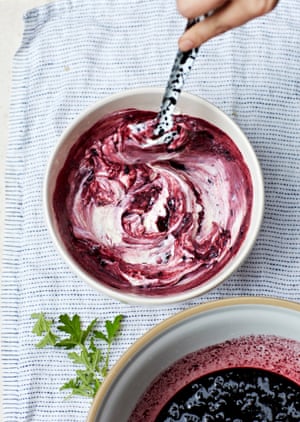
Frozen blackberry-geranium cream
Makes around 2 litres
5 geranium leaves, rinsed, slightly torn
400g double cream
200g caster sugar
1.5kg blackberries
1 Add the geranium leaves to the cream along with 50g of caster sugar. Allow them to steep overnight in the fridge.
2 The next day, macerate the berries in the remaining 150g caster sugar for an hour to extract some juices and sweeten the berries. Whizz the berries and any juices in a food processor or mash with a wooden spoon or mallet.
3 Strain out the leaves and lightly whip the cream. Fold in the berry mash.
4 Transfer to a suitably sized container and freeze for at least 4 hours.
Blackberry cake doughnuts
The dough can be made the day before.
Makes 6
640g extra fine sponge flour
3 tsp baking powder
A grating of nutmeg
2 tsp fine sea salt
Zest of 2 lemons
200g butter
200g sugar
4 egg yolks
300g plain yoghurt
Vegetable oil, for frying
For the glaze
300g blackberries
1 tsp lemon juice
400g icing sugar
½ tsp salt
Hot water
1 First, make the doughnut dough. Sift together the flour and baking powder. Whisk in the nutmeg, salt and lemon zest. Set aside.
2 In the bowl of a stand mixer or with a handheld electric mixer, cream together the butter and sugar – but only until smooth and creamy; not pale and fluffy. Add the yolks one at a time, mixing well after each addition. Add the yoghurt and mix well.
3 Add the dry ingredients to the wet ingredients, and mix them into a dough. Turn out on to a piece of clingfilm. Wrap and chill the dough for 2 hours.
4 On a liberally floured surface, roll the dough out to 2cm thick, and cut out as many doughnuts as you can using a 9cm round cutter. Pat the scraps together and re-roll one more time to get about 6 doughnuts all together. Remove the holes, and fry and glaze them as you do the doughnuts. Score lines on top of each doughnut in a pentagonal pattern.
5 Heat the vegetable oil to 180C/350F. Fry the doughnuts for 4-5 minutes on one side (until golden), and then for 2‑3 minutes on the second side, or until equally golden.
6 To make the glaze, puree the blackberries in a food processor. Strain through a sieve to remove the seeds. Mix with the lemon juice, then add the icing sugar and salt, and whisk to combine. If the glaze is a little thick, you can add a drop of hot water.
7 Dip the warm doughnuts into the glaze, then put on a wire rack to cool with a tray underneath to catch the drips.
- Claire Ptak is a pastry chef, author and food stylist and owns Violet Bakery in London. She is the author of the Violet Bakery Cookbook (Square Peg); @violetcakeslondon
0 comments:
Post a Comment